
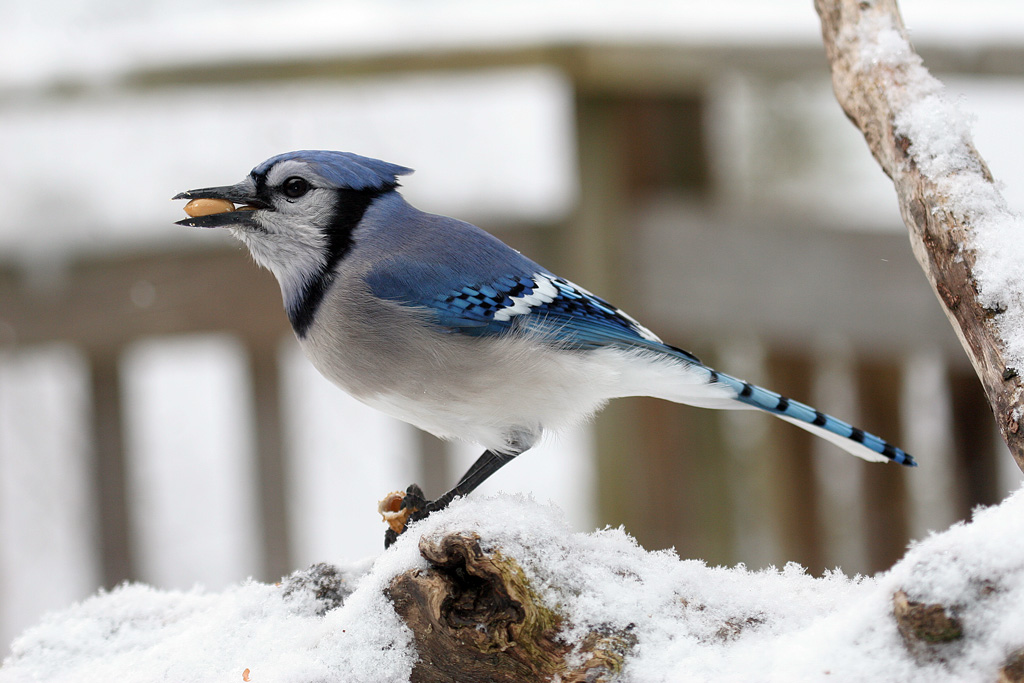
Bird feeders are a staple of suburban America, whether they are window-mounted or hopper feeders, filled with sunflower seeds, peanuts, or thistle. Hundreds can be spotted in every city from New York to California, inviting an entourage of visitors, from jays to sparrows, wrens, and woodpeckers.
For much of the twentieth century, watching these birds fly in and out of backyards was little more than a hobby, until 1976, when ornithologist Dr. Erica Dunn, her husband, and a team of volunteers first began the Ontario Bird Feeder Survey. Based at Canada’s Long Point Bird Observatory, the survey initially had fewer than one hundred members. Dunn and her team posted advertisements in the papers to pique public interest. This project was an early attempt to engage the public in a citizen science organization. It would not only inform people about native birds but also provide more consistent data on avian movements across Canada, assisting researchers around the world. The original project ran for ten years, transitioning from adding machines to punch cards as technology evolved to simplify the counting and data collection process.
By 1986, the project had grown substantially, and Long Point made the decision to reach out to the Cornell Lab of Ornithology, which used contacts across the US as well as state-of-the-art technology to not only expand the project’s range but also its efficiency. In combination with the expertise Long Point had acquired from its decade of work with its own birdwatchers, the two made the perfect team.
Today, almost fifty years after the project’s beginning, FeederWatch has thousands of participants across North America, with the creation of an app making registering counted birds easier than ever. All of this has allowed scientists to better track and understand the movements of both migratory and non-migratory birds alike. It continues to be a successful example of citizen science that serves to gather essential data, educate the population about birds, and foster a diverse community of bird watchers united around a common goal.
Some of Project FeederWatch’s most interesting findings include the effects of urbanization on bird population and spread. Cardinals and grosbeaks exhibit the starkest contrast. Northern cardinals can thrive in suburbia, with the abundance of bird feeders and other sources of human-facilitated food, which has led to their spread and population increase. Grosbeaks, however, have lost vital nesting ground in northern coniferous forests, leading to a population decline as well as a general move northward. FeederWatch and studies like this are critical in allowing scientists to track the environment in which different species can survive and, more importantly, when they are endangered and might need human support.
Local opportunities such as the Lab of Ornithology’s live feeder cam and the Sapsucker Woods Sanctuary allow the community to get closer to and learn more about the conservation of our local species through direct observation. The Lab of Ornithology also provides multiple year-round opportunities, like the Migration Celebration, to further engagement with the lives of birds. Each season starts on November 1 and runs through April, but participants can join at any point in the FeederWatch season. If you are interested in participating in this year’s season, visit https://feederwatch.org/ for more information.