
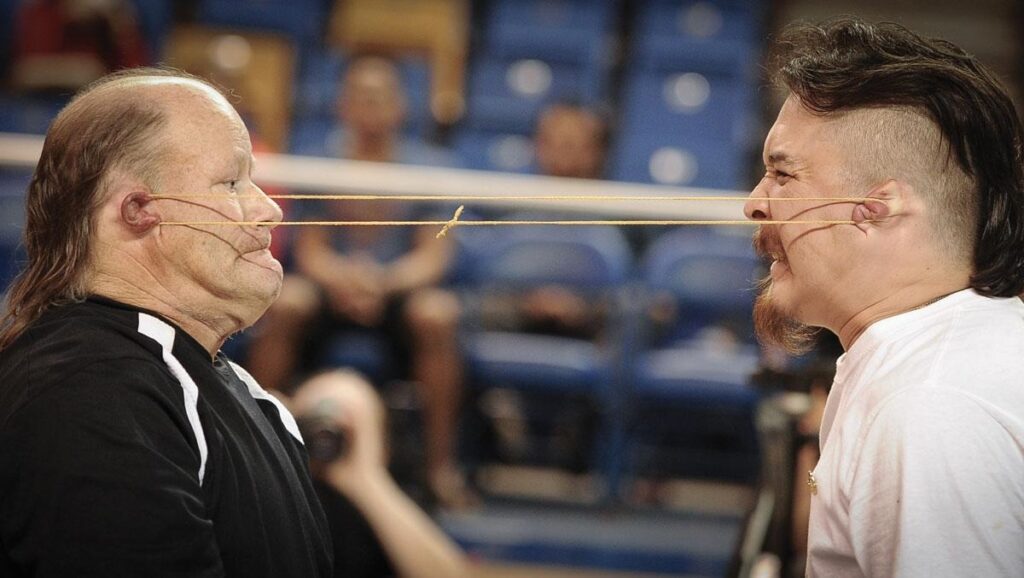
When we think of the qualities of an athlete, we tend to think of brute strength or impressive flexibility. In reality, physical attributes are only one part of the story—mental strength, concentration, and endurance play a major role in an athlete’s success. Ear pull, a traditional Inuit sport, is an excellent example of how physical and mental strength intersect.
Ear pull is a one-on-one game, with an animal sinew or wax string as the only equipment. Players sit facing each other in a straddle and interlock their legs for stability. The string is wrapped around each player’s ear, creating a long loop between them. Then, players slowly pull back from each other, tightening the sinew and increasing the intensity of the game. A player wins when either the sinew falls from their opponent’s ear or their opponent forfeits due to the pain. Players often bleed during and after matches and, in extreme cases, need stitches.
For decades, Inuit sports like ear pull have taught players life skills that were imperative to their survival in Alaska’s remote communities. But they serve another purpose: they help young people recover from substance abuse disorders by reconnecting with cultural traditions. Due to factors such as historical trauma, racism, and insufficient access to medical care, Native American youth ages twelve to seventeen use cigarettes and marijuana at a rate much higher than the national average. Practicing these sports gives Native American youth in recovery a vital sense of purpose and connection.
While these games have been played within Inuit communities for decades, they received a national stage in 1961 during the World Eskimo-Indian Olympics (WEIO). The week-long event features competitions, medalling ceremonies, and performances similar to the Olympics. Unlike the Olympics, however, the WEIO prioritizes community over competition. Older competitors are often seen mentoring younger players, and athletes describe the games as more of a competition with themselves than with their opponents.
Beyond ear pull, the WEIO currently hosts over twenty unique events, each requiring different combinations of physical and mental skills. These other events include the four-man carry, in which one person attempts to carry four people draped across their body; the stick pull, which mimics the feat of pulling a seal from ice; and the two-foot high kick, in which an athlete jumps in the air to kick a sealskin ball suspended on a string.
In the face of cultural erasure, ear pull and the WEIO are major players in preserving Inuit culture. They also serve as a reminder that sports require more than just physical ability—successful ear pull players also have incredible endurance and a strong sense of culture and camaraderie. WEIO’s growing audience suggests that maybe someday, games like ear pull will rival football and baseball as quintessential parts of the American sports culture.