
This past year, there have been many calls for the ICSD Board of Education (BoE) to listen to student voices and to value student input. For example, in the December 2025 issue of The Tattler, the Editorial Board wrote: “The Tattler believes that the district must heed student feedback and act on it with greater urgency for the sake of the district as a whole.” The editors went on to express concern that BoE student representative positions are largely symbolic and have limited impact on decisions.
But, there is a way for anyone—including students—to speak directly to the BoE. That is important because the BoE is responsible for developing the district’s budget, setting district policies, and hiring and firing the superintendent. In other words, they are ultimately in charge of most activities happening in ICSD schools.
The BoE enables the voices of the public to be heard through public comment sessions during their meetings. At the beginning of each voting meeting, students, staff, families, and any other members of the public can present their views to the BoE for up to three minutes. Up to thirty minutes are allotted for this, and the time can be extended as well. There are also opportunities to speak at other types of BoE meetings, including at committee meetings.
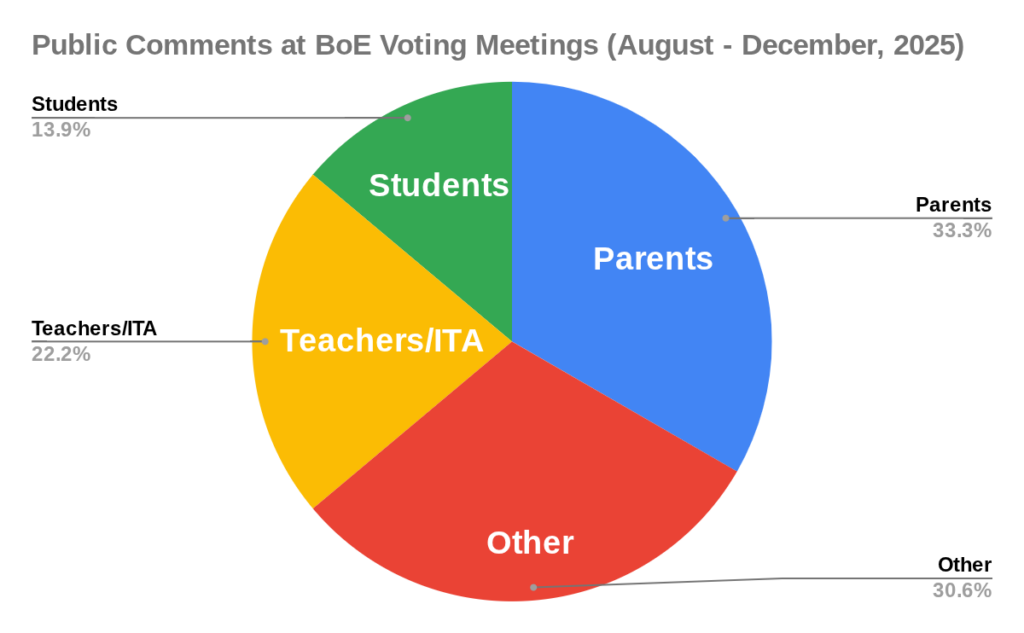
To determine how the public comment sessions are utilized, especially by students, I watched the video recordings of all the voting meetings between August and December (anyone can watch these meetings–they are publicly available). Of the nine voting meetings, eight had public comments. In total, thirty-six public comments were made. Interestingly, half of the comments were made at a single voting meeting: the meeting at which the BoE decided to extend the contract of current superintendent Dr. Luvelle Brown.
As shown in the chart below, only five of the thirty-six comments were made by ICSD students. The majority of meetings had no students speaking. Of the five students speaking, four were from IHS, and one was from an elementary school. Of the other comments, twelve were made by parents of students, eight by district staff or by representatives from the teacher’s union, and eleven by other community members (some of whom are affiliated with the school district in other ways).
To evaluate the potential impact of student input, it is important to consider not only how many students spoke, but also what was included in their comments. Two students did not make specific requests, and another made a request that would have required major construction. Although general feedback is valuable, specific requests are more useful because they tell the BoE exactly what they should do.
Laura McKenna, writing for The74, a nonprofit news organization focused on issues that affect American children, advises those who wish to speak at BoE meetings to offer specific solutions rather than general criticism. By contrast, generalized complaints and comments that do not propose a particular action leave the BoE to evaluate the problem themselves and require them to develop their own solutions.
Furthermore, it is easier to measure progress with regard to specific requests. For example, if a student suggests that the BoE be more transparent, it is difficult for the BoE to measure how transparent it is and whether it is sufficiently transparent. If, however, the student proposes a particular solution (such as emails to all school accounts about BoE meetings), the BoE can measure its progress and determine when it has met the goal. This encourages BoE members to continue to work until they reach the specific goal, rather than simply thinking, “we are already doing a good enough job.”
Students and others who wish to speak at BoE meetings must fill out a form that asks things such as their name, address, topic on which they will comment, date they would like to speak, and whether they will be attending in person or virtually. The form, as well as information about meetings and recordings of prior meetings, can be found at ithacacityschools.org/o/icsd/page/board-meetings. One may speak about almost any topic concerning the BoE (the BoE does place certain limits on discussing individual people). One may, however, want to check the meeting agendas (accessible using the same link from above) to determine the most appropriate meeting at which to speak.
When deciding what to say, focus on things that are important, but also doable. For example, consider the cost of your proposed solution. Given budgetary constraints, lower-cost solutions are more likely to be adopted. McKenna also suggests doing some research prior to the meeting. She says, “school board members are volunteers […] they don’t have the time to research every topic related to schools. So, help them out. Show up with numbers, research, and facts that they can use as they make decisions.”
State law does not require school boards to have public comment sessions, but the ICSD BoE chooses to hold these sessions and listen to public input. For students who want to make their voices heard, this is a currently underutilized opportunity.