
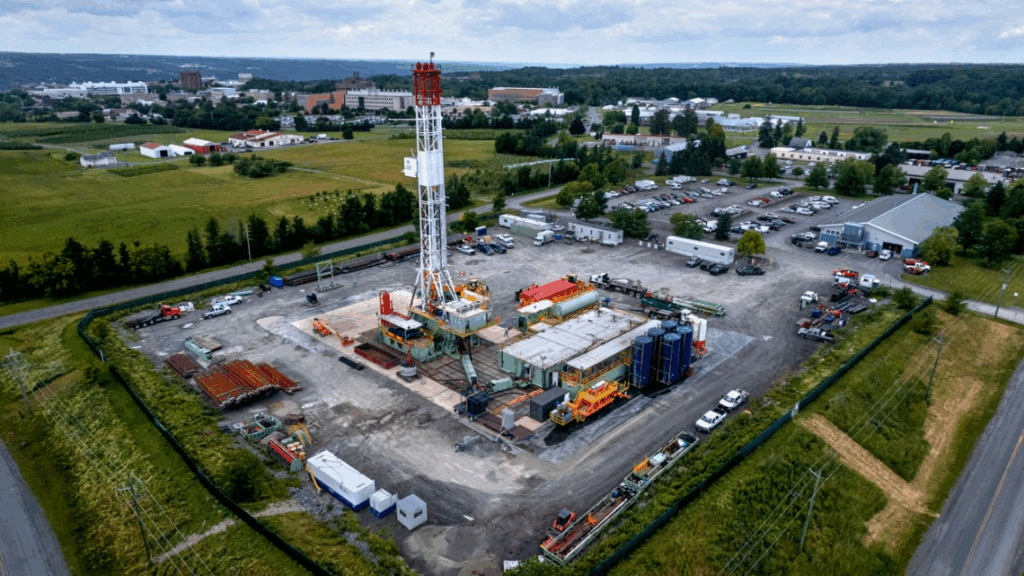
Cornell University’s push to heat its Ithaca campus with rock-steady geothermal energy has entered a decisive new phase. Data from a nearly two-mile exploratory well drilled in 2022 are now guiding the design of an Enhanced Geothermal System that could replace most on-campus fossil fuel heat with steady, low-carbon warmth. The project, branded Earth Source Heat, is designed to deliver reliable baseload heat in a cold climate. It also anchors Cornell’s plan to reach campus carbon neutrality by 2035.
The technical backbone begins with the Cornell University Borehole Observatory, known as CUBO. The well descends 9,791 feet, crosses about 2.8 kilometers of sedimentary layers, and enters crystalline basement rock where temperatures reach roughly eighty to eighty-two degrees Celsius. That thermal profile, paired with a measured gradient near twenty-three degrees per kilometer, confirms enough heat at depth for direct-use district heating. The borehole was funded largely by the U.S. Department of Energy (DOE), which provided approximately 8.18 million dollars toward a total deployment cost of nearly 14 million dollars.
Cornell’s current heating system still relies heavily on fossil fuels, making it a major source of campus emissions. At the same time, ongoing upgrades to a low-temperature hot water network create the infrastructure needed to connect future geothermal heat sources. On peak winter days, campus heat demand reaches about ninety megawatts thermal. Today, a combined heat and power plant supplies roughly ninety percent of that load, with conventional gas boilers covering the rest. To cut carbon emissions, Cornell is replacing its steam-based heating network with a low-temperature hot-water system. The goal is to keep supply temperatures at or below eighty degrees Celsius, and to design new buildings so they can be heated with water as cool as fifty-five degrees. These changes will allow geothermal heat to be used more efficiently across the campus.
Enhanced Geothermal Systems (EGS) are at the heart of Cornell’s plan. Instead of finding a naturally porous underground reservoir of hot water, engineers make their own by creating small cracks in deep, hot rock. Water is pumped into these cracks, absorbs heat from the rock, and is then brought back to the surface.
Cornell’s design, based on data from the CUBO well, calls for two deep wells connected underground. One well would inject cool water, the other would bring the heated water back up. Computer models suggest that each pair of wells could deliver about five to ten megawatts of steady heat for roughly fifteen years before temperatures begin to drop noticeably. To do this, the fractures underground would need to cover about two to three square kilometers. The system would pump thirty to fifty liters of water per second at temperatures between twenty and forty degrees Celsius when injected.
Those numbers matter because they scale. Cornell’s public planning documents describe a baseload system that ultimately covers about ninety-five percent of annual campus heat, with a separate renewable peaking source handling the coldest twenty or so days each year. An initial demonstration well pair would serve a portion of the current load; if results match models, additional pairs would be installed in phases over the next eight to ten years. The university has also modeled operations with central heat pumps to lift temperatures when needed and estimates a levelized cost of heat on the order of forty dollars per megawatt-hour for the EGS-plus-heat-pump configuration, assuming typical financing.
Safety and monitoring are part of the engineering plan. Ithaca rarely experiences earthquakes, but Cornell installed local seismic sensors years before drilling to record a baseline level of ground movement. This is important because creating fractures deep underground can sometimes cause very small, natural-like tremors. The current CorNET21 network includes seventeen seismometers across the region, making it far more sensitive than national systems. The campus also shares regular updates and maps of equipment locations near the CUBO site so neighbors can see how monitoring is set up.
The pathway from rock to radiators is straightforward in concept and complex in practice. Water would be injected into the deep, engineered fracture network, warmed by contact with hot rock, and produced back to the surface. Heat exchangers and large heat pumps would transfer that heat into the campus hot-water network; the cooled water would be reinjected to complete the loop. Because the system targets steady output rather than electricity, the design can run at very high capacity factors near the full heating season. Cornell’s District Energy Team has already integrated similar infrastructure on the cooling side through Lake Source Cooling, which cut summer electrical demand by replacing chillers with cold deep-lake water. Those operational lessons transfer directly to geothermal heat.
Funding and policy support have helped the work move from concept to field data. DOE grants for campus-based geothermal exploration, paired with Cornell investment, enabled the CUBO well and subsequent testing. DOE’s broader EGS demonstration program is also building national momentum for varied geologies, a signal that district-scale geothermal heating is a strategic priority rather than a niche experiment.
What happens next will be visible in two places at once, underground and on campus. Below the surface, engineers are refining stimulation designs to create the necessary heat-transfer area while maintaining control of fluid pathways. Above ground, facilities crews continue converting buildings to lower-temperature hot water so geothermal heat can be used efficiently as each new well pair comes online. If Cornell’s demonstration produces the expected five to ten megawatts thermal per doublet with stable performance, the campus could begin a measured buildout that replaces most of its fossil fuel heat over the coming decade. That outcome would cut a major share of campus emissions and offer a replicable template for other cold-weather districts with similar geology.
The stakes are not hypothetical. Heating accounts for a large fraction of Cornell’s operational emissions, and the 2035 neutrality goal is fast approaching. EGS gives the university a path to anchor its heating with renewable baseload energy rather than volatile fuels. With a three-kilometer test well now logged to the bottom, temperatures around eighty degrees Celsius confirmed, and an engineering model that translates rock physics into megawatts, Cornell’s geothermal future is no longer just a theory. It is a plan with measurements, timelines, and a clear destination.