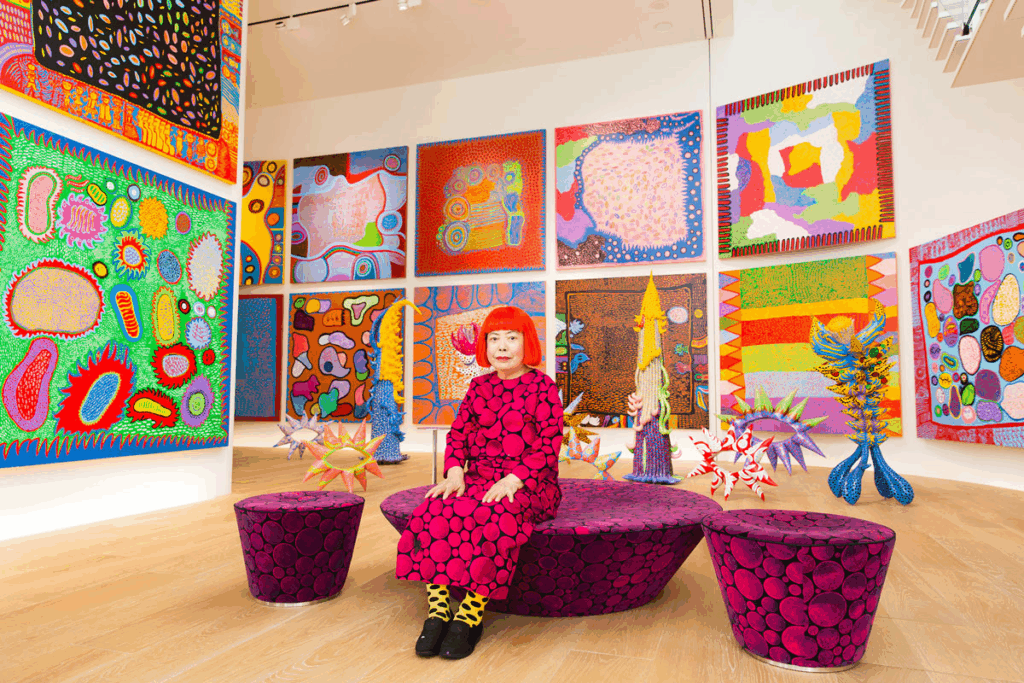
“Our world is only one polka dot among a million stars in the cosmos. Polka dots are a way to infinity,” are words said by Japanese artist Yayoi Kusuma, notorious for her creative use of polka dots and artistic techniques in her works. For decades, Kusuma has been known for her unique approach to her works that often feature polka dots oriented in special ways to embody depth and personal connections through her pieces. This unique approach to art has led to her great success: she was named one of the top one hundred most influential people for Time Magazine and became the first Japanese woman to represent her home country at the Venice Biennale, an annual political and social art exhibition held every two years in Venice, Italy.
While Kusuma had very limited opportunities to pursue art growing up, and was encouraged by her family to pursue a more “conventional” career path, Kusuma persisted in her passion of art. By the 1950s, Kusuma began showcasing her art in local exhibitions in her hometown of Tokyo. Soon, her work was available in many other exhibitions around the world, such as in San Francisco, Ontario, London, and Amsterdam. In 1957, her work was showcased in Seattle, and her pieces Infinity and Decalcomania were both displayed. Both of these pieces use different artistic techniques to showcase microscopic biological forms of life.
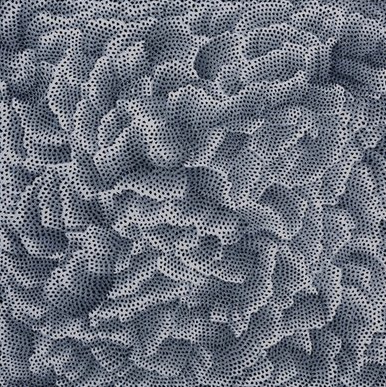
Additionally, much of Kusuma’s work is reflective of her personal life. For example, her Infinity Net painting collection is symbolic of the various difficulties she faced upon moving to New York for the first time in the 1960s. These paintings capture aspects of various art forms such as minimalism and abstract expressionism, adding to the beauty and intricacies in the simple yet captivating depth of this art. Kusuma’s current project is the series My Eternal Soul, which is made up of over five hundred different pieces. Together, they are a reflection of Kusuma’s earlier pieces, and represent themes of sublimity and infinity.
Beyond this, Kusuma’s works range across all different art expressions. Her Accumulations collection is a series of what she calls “soft sculptures,” where she uses phallic tubes and attaches them to pieces of furniture as a reflection of her own efforts to overcome her personal fears of various ideas. She has also used fashion as a reflection of her story, such as in The Walking Piece in 1966, in which a woman in a pink kimono is centered in a Western city, as a way to juxtapose the two with each other.
Kusuma’s works are truly unique for the wide range of qualities and ideas they reflect. Kusuma’s story, creativity, and drive to continuously create works to this day are nothing but inspiring and a remarkable demonstration of the various different art forms she utilizes in showcasing these ideas.