
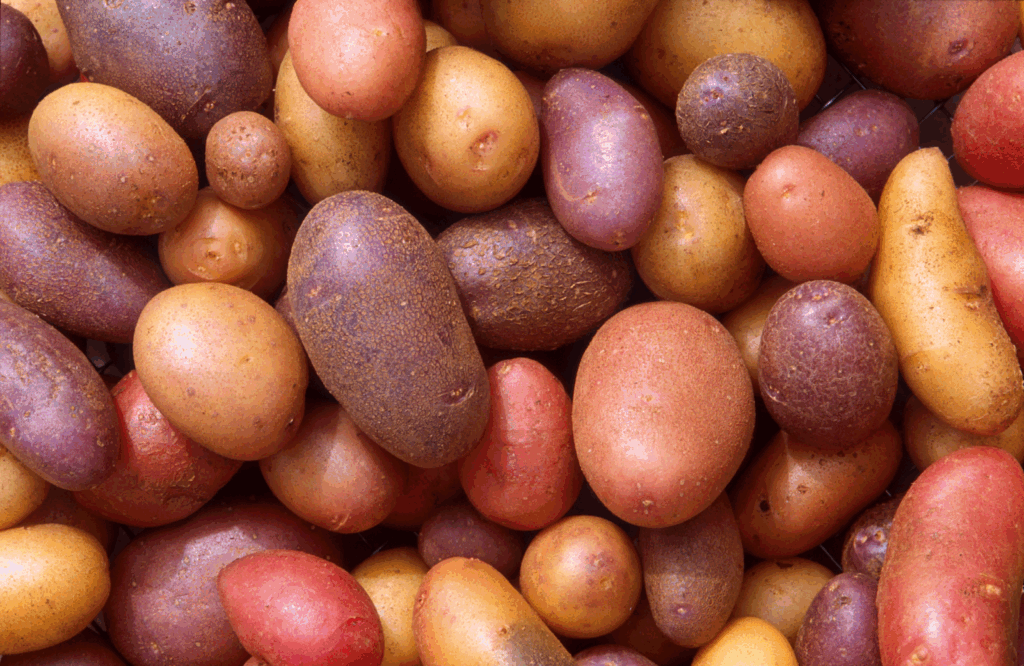
Potatoes are one of the most versatile crops in the world. You can fry them, bake them, mash them, boil them… the options are truly endless. Each culture has its own way of cooking this hearty veggie. Yet, for centuries, “We didn’t know where the whole potato lineage came from,” said Sandy Knapp, a botanist at the Natural History Museum in London. But now, scientists have uncovered the mysterious origin of potatoes.
Before we can understand the origins of the potato, we need to take a closer look at the potato. Potatoes are not really roots like one might think; rather, they are underground stems called tubers. These tubers look similar to a root structure, but can store carbohydrates and other nutrients, and allow for the reproduction of potatoes without seeds or pollination.
The domesticated potato, Solanum tuberosum, belongs to the Solanaceae, or nightshade family. Other plants within this family include tomatoes, tobacco, eggplants, and peppers. Scientists have long known that within the Solanaceae family, potatoes are most closely related to tomatoes and a cluster of South American potato-like plants called Etuberosum. However, scientists were unable to determine the family tree of potatoes because the presence of certain genes suggested that potatoes were more closely related to tomatoes, while other genes suggested Etuberosum was a closer relative. Additionally, the story of potato’s origin was further muddied by the fact that neither tomatoes nor Etuberosum have tubers.
To try and finally uncover the hidden past of potatoes, scientists at the Chinese Academy of Agricultural Sciences performed genetic sequencing and conducted the most extensive genomic analysis on the domesticated potato. 128 different genomes were analyzed for their study, with plants tomatoes, Etuberosum, potatoes, wild potatoes, and eggplants all being sequenced. The study found that modern domesticated potatoes have a mixed ancestry, arising from a hybrid tomato-Etuberosum lineage somewhere between eight and nine million years ago. Somehow this hybridization led to the formation of tubers, and thus the tuber potato was born and subsequently spread around the whole world.
The study’s comprehensive genetic analysis identified key genes that impact tuber formation. Researchers found that the SP6A gene, which controls whether tubers should begin to form or not, comes from ancient tomatoes. Conversely, the IT1 gene, a gene that regulates the growth of the underground stems which ultimately becomes edible tubers, comes from the Etuberosum family. These two genes highlight how unique the potato is, and how it is truly the ultimate combination of both tomato and Etuberosum.
Finally having found how tubers originated, scientists are able to have a better understanding of what enabled potatoes to diversify and expand their range across a variety of landscapes like the cold climate of the Andes mountains. As one researcher at the Chinese Academy of Agricultural Sciences, Zhiyang Zhang, says, the tuber is a “good weapon” against the harsh climate of high elevation, allowing potatoes to reproduce quickly and efficiently. The results from this study have opened up doors to many future studies. Potatoes are currently propagated via cloning, meaning that farmers use little chunks of potato to create new potato plants. This method of propagation limits their genetic diversity and makes them more susceptible to disease. Introducing new genes from its ancestors such as tomato or Etuberosum could help potatoes become more resilient to disease and adapt to a changing environment. Potatoes can also be modified to produce seeds such that farmers can breed potatoes similarly to how tomatoes are bred. Who knows, maybe in a few years we’ll have potato seeds that you can plant on a beach.