
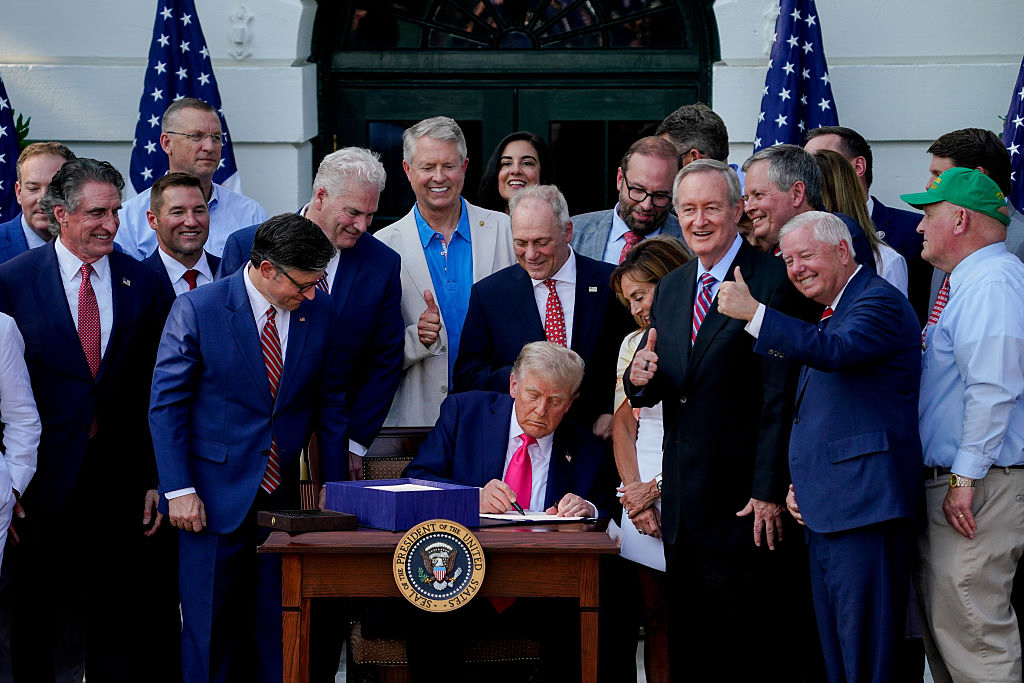
One of Donald Trump’s signature promises during his 2024 presidential campaign was to cut government spending. Trump claimed his reductions would shrink the size of the federal government, curb bureaucracy and waste, and increase efficiency. This summer, with congressional support, he signed those cuts into law.
Early in his administration, Trump acted unilaterally by issuing executive orders to scale back federal agencies and create the Department of Government Efficiency (DOGE), headed by former Tesla CEO Elon Musk. DOGE targeted agencies for dismantling, advised firing tens of thousands of federal employees, and cut funding for foreign aid and research.
However, there was a limited extent to what Trump could do with DOGE and his executive actions. Under Article I of the Constitution, only the legislative branch can control federal spending. This meant Trump needed legislative approval from Congress for his most sweeping cuts. The cuts were bundled into the One Big Beautiful Bill Act (OBBBA) during budget reconciliation, a process to change revenue, spending, and debt-limit laws that bypasses the Senate filibuster by requiring only a simple majority to pass a bill. The OBBBA, a sprawling package of hundreds of provisions, made permanent the 2017 tax cuts of Trump’s first administration, increased the state and local tax deduction cap, and created new deductions for tips and overtime. In an effort to strengthen national security, it gave hundreds of billions in new funding to the Department of Defense and Immigration and Customs Enforcement.
Many of the bill’s spending cuts proved to be contentious. The OBBBA cut over one trillion dollars of funding for Medicaid, a federal health insurance program for low-income Americans. At least ten million people could be removed from coverage because of tightened eligibility through work requirements and reduced provider funding due to tax cuts. The OBBBA also reduced funding for the Supplemental Nutrition Assistance Program (SNAP), which runs programs such as food stamps for low-income families. The cuts are expected to remove millions of people around the country from the service.
Supporters of these cuts argued that Medicaid and SNAP were being used to support people who did not need help from the program in the first place, creating artificial dependence on the government. By tightening eligibility requirements, the country could save billions of dollars and ensure that Medicaid and SNAP benefits would reach the people who were most in need. Critics warned that such drastic spending cuts would cause hospital closures, healthcare layoffs, and raise the cost of living for families. A fifty-billion-dollar rural hospital relief fund was added to the bill, but it was widely seen as inadequate to alleviate the consequences of the cuts. The OBBBA also eliminated many clean energy tax credits, a move some argued would slow the rate of renewable manufacturing, raise consumer energy costs, and weaken energy competitiveness in a time of rapidly growing demand.
Cuts to SNAP and Medicaid prompted opposition from Republican Senators Thom Tillis of North Carolina and Susan Collins of Maine, who warned of harm to their constituents. Fiscal conservatives like Senator Rand Paul of Kentucky and some members of the House’s conservative Freedom Caucus objected to the bill’s deficit impact—tax cuts had outweighed spending reductions, leaving trillions in projected debt over the next decade.
With three Republican senators opposed, pressure mounted on Lisa Murkowski of Alaska, who ultimately backed the bill after securing exemptions to SNAP cuts for her state. Her vote created a fifty-to-fifty Senate split, broken in favor of the bill by Vice President JD Vance. The House approved the revised bill, and Trump signed it into law.
The OBBBA’s sweeping provisions are expected to have significant and lasting effects, both nationally and within our own community. In Ithaca, roughly 13.7 percent of residents rely on Medicaid for healthcare. Under the bill’s new eligibility restrictions and funding cuts, thousands of local residents are projected to lose health insurance entirely, while many others may face longer wait times or more hurdles in accessing care. Hospitals in the Cayuga Health System, some of which are designated as federal rural health clinics, could be especially vulnerable.
The legislation’s reductions to the Supplemental Nutrition Assistance Program (SNAP) will also have far-reaching consequences. Many Ithacans depend on SNAP to afford basic groceries, and any decrease in benefits could strain household budgets, increasing food insecurity. Local retailers and the Farmers Market, which benefit from SNAP purchases, may also feel the economic ripple effects of reduced consumer spending.
After the OBBBA’s passage, the Senate’s attention turned to Fiscal Year 2026 appropriations to ensure funding for the federal government. The budget process runs from the agency’s requests to the Office of Management and Budget (OMB), which drafts a proposal for the President and gives it to Congress. Democrats worry about the politicization of the process, citing OMB Director Russell Vought’s role in Project 2025, a conservative initiative to restructure government and consolidate executive power. With no appropriations bills passed and Congress being in recess, lawmakers must rapidly pass appropriations packages in September or face the threat of a government shutdown when the new fiscal year begins on October 1.
While the full consequences of the OBBBA will unfold over time, its influence will likely extend into the appropriations process now underway. Funding decisions for Fiscal Year 2026 will determine whether certain programs and agencies face further reductions or receive targeted relief. The outcomes could shape the future of our healthcare system, food security, and economic stability for years to come.