
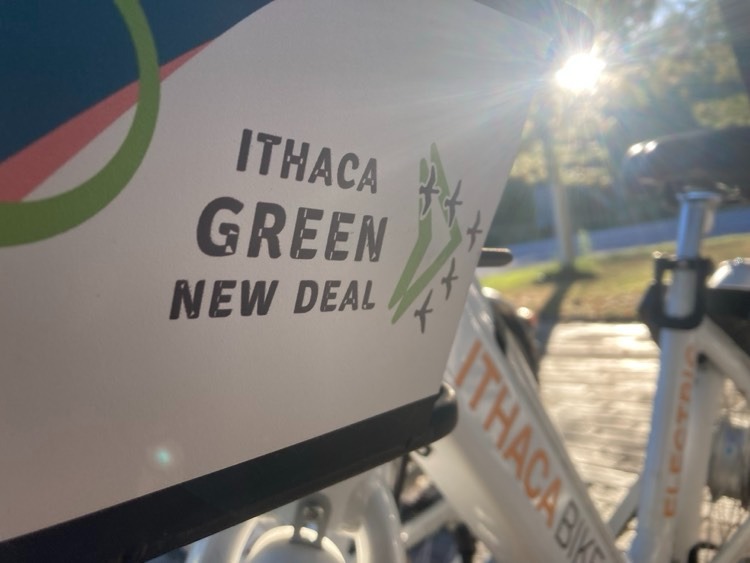
Ithaca’s Climate Action Plan (CAP), at the heart of the City’s Green New Deal, is getting a makeover.
Whereas previous iterations focused almost exclusively on reducing emissions toward a “net-zero” goal, the current plan seeks to cover a wider array of climate change effects—both in terms of mitigation and adaptation. The latter acknowledges that some effects of climate change will not be preventable, at least in the short term, and that City policy must help residents adapt to them.
The CAP also seeks to make the most of constrained budgets, both locally and federally. According to WAMC Northeast Public Radio, eighty-five percent of the City’s Green New Deal funding, amounting to 2.5 million dollars, was frozen by the Trump administration in February.
The Ithaca Green New Deal (IGND) was first adopted by the City of Ithaca Common Council on June 5, 2019. So far, its progress has included Justice50, a plan to prioritize spending toward disadvantaged communities citywide; regulations requiring new construction to meet zero emissions energy standards by 2026; and a local Community Choice Aggregation law allowing for the development of affordable carbon-free energy for all.
But recently, the IGND hasn’t been so smooth sailing. Almost a year ago, Rebecca Evans, Director of Sustainability for the City of Ithaca, posted a “long but important and earnest update” on LinkedIn. In it, Evans said that the IGND hadn’t gotten City money since 2021 and had been surviving only on grant money. She said in the post that she wrote the initial CAP in 2023 “in an over-caffeinated fever dream of endless funds and capacity”; it couldn’t hold together in the rough conditions.
Evans wrote in the post that instead of rigidly focusing on getting to zero emissions as the old plan had guided, the new plan would prioritize allowing the community to “thrive socially, economically, and environmentally,” and that net-zero would follow if these steps were taken. Now, about a year later, that plan is getting ready to launch.
A draft of the new CAP has been released and is now open for public comment in the form of two public surveys, one about housing and labor and the other about public health and equity, which will be followed by one about power reliability and emergency response to be released soon. The surveys are available online and are hosted via the City’s OpenGov platform. The IGND webpage says that the new plan will put “Ithacans’ everyday struggles and opportunities at the center while staying aligned with City legislative and development priorities.”
The proposed CAP will be divided into six segments: Housing, Labor, Public Health, Racial Equity, Electric Reliability, and Emergency Response. In an info page about the updates, the City says that taking this multifaceted path will help reduce emissions while prioritizing the well-being of Ithacans amid the inevitable effects of climate change. Some examples of recommendations in the proposed plan include flood guidelines for new construction, piloting programs to distribute heat pumps to renters, and creating enhanced, rapid bus systems.
But what’s to stop the new plan from getting off track like it had previously? Local climate justice advocate and TC3 environmental science major Zach Schmitt asserts that the new plan would hold up better than former iterations, because much of the project will be able to be completed locally without the need to rely on outside parties. Schmitt said that in a past arrangement between Brooklyn-based BlocPower and the City, almost all buildings in Ithaca would have been fitted with electric heating systems. The company ended its partnerships with many cities, including Ithaca, and so the electrification project—one of the main parts of the Green New Deal at the time—became unfeasible. Schmitt highlighted that the new plan will be very focused on local initiatives, with little need for outside partnership, making it more resilient.
Schmitt said that Sunrise Ithaca, the organization he advocates with, helped realize the new CAP by advocating and providing feedback from a community perspective.