
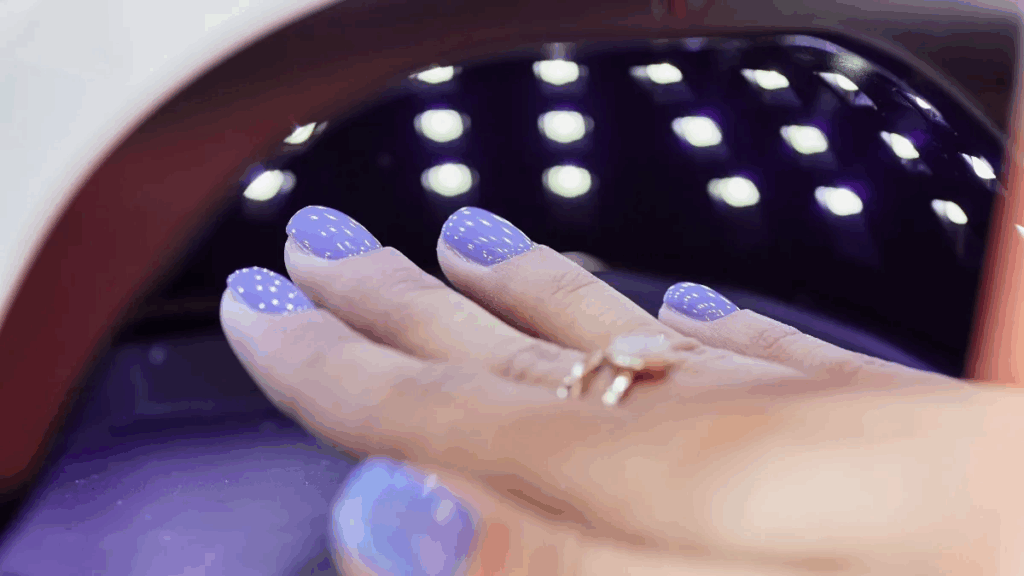
I, like many other teenagers, love to get my nails done, whether it’s a simple color or a fun design. I’ve always known that gel nails last longer than regular polish, but how does gel nail polish actually work?
The first step in understanding how gel nail polish works is by understanding the concepts of monomers and polymers. A monomer is a small, simple molecular building block. When these monomers combine and join together, a polymer forms. All nail polishes dry to become polymers that coat the top of the natural nail. Regular nail polish is made out of a film-forming compound called nitrocellulose, and as the solvents in nail polish evaporate, a polymeric film forms atop the nail. Gel nail polishes, on the other hand, are based on acrylic polymers that are not able to polymerize simply via drying time like traditional nail polishes do. Two common monomers in gel nail polish are hydroxyethyl methacrylate (HEMA) and di-HEMA trimethyl-hexyl dicarbamate. These monomers form cross-linkages between polymer chains, allowing gel nail polish to form an interconnected network of polymers. This network is why gel nail polish is so durable and chip-resistant.
Gel nail polish also contains molecules called photoinitiators. Photoinitiators absorb ultraviolet (UV) light and split into compounds called radicals, which are highly reactive, kickstarting the process of polymerization in nail polish. As you cure your nails under UV light, the photoinitiators get charged and force the monomers to start forming long and cross-linked polymer chains. One very common photoinitiator is trimethylbenzoyl phosphine oxide (TPO). TPO was actually banned by the European Union (EU) in September, over concerns of it causing reproductive issues. The EU’s decision to ban TPO is due to many studies finding a risk of negative reproductive outcomes for male rats when fed TPO at high dosages. Two cosmetic chemists, Kelly Dobos and Doug Schoon, have explained that gel nail polish very likely does not cause reproductive harm in humans, as TPO is present in rather low levels. They argue that since people are not eating gel nail polish or are surrounded by a very high concentration of TPO like that used in the rat studies, getting one’s nails done once in a while will unlikely cause infertility. Nevertheless, more TPO-free nail products will likely be developed as brands reformulate to create globally-accessible products.
One crucial part of the gel manicure process is curing under UV lamps. UV light is needed to split the photoinitiators to allow them to do their job. Some concerns exist regarding whether the UV light from nail lamps can cause skin aging and cancer. Some studies have found that typical UV lamps can cause DNA damage to human cells in vitro (in a test tube), while others suggest that it would take thousands of hours under a lamp to reach the threshold for serious DNA damage to occur in the skin. Regardless, the American Academy of Dermatology recommends that people protect their skin with sunscreen when getting a gel manicure in order to reduce the amount of cumulative UV damage over one’s lifetime.
It is also important to note that HEMA and other acrylates/methacrylates (the acrylic monomers in gel nail polish) are skin irritants and sensitizers. Typically, this is not an issue for many people, as the chemicals are only applied to the nail, which is not porous. However, if these chemicals repeatedly touch skin, they can cause contact dermatitis, a type of allergic reaction. But it is important to try and avoid touching uncured gel nail polish. The consequences of an allergy to acrylates go beyond simply switching from gel nail polish to regular polish. Acrylates are used in medical products, such as bone cement, dental fillings, and diabetic insulin pumps. This means that if one develops an allergy to acrylates, the impacts can be lifelong. Thus, precautions need to be made to avoid having wet nail polish touching the skin.
All in all, understanding the science behind gel nail polish can allow people to make informed decisions and ensure good practices when one gets their nails done.