
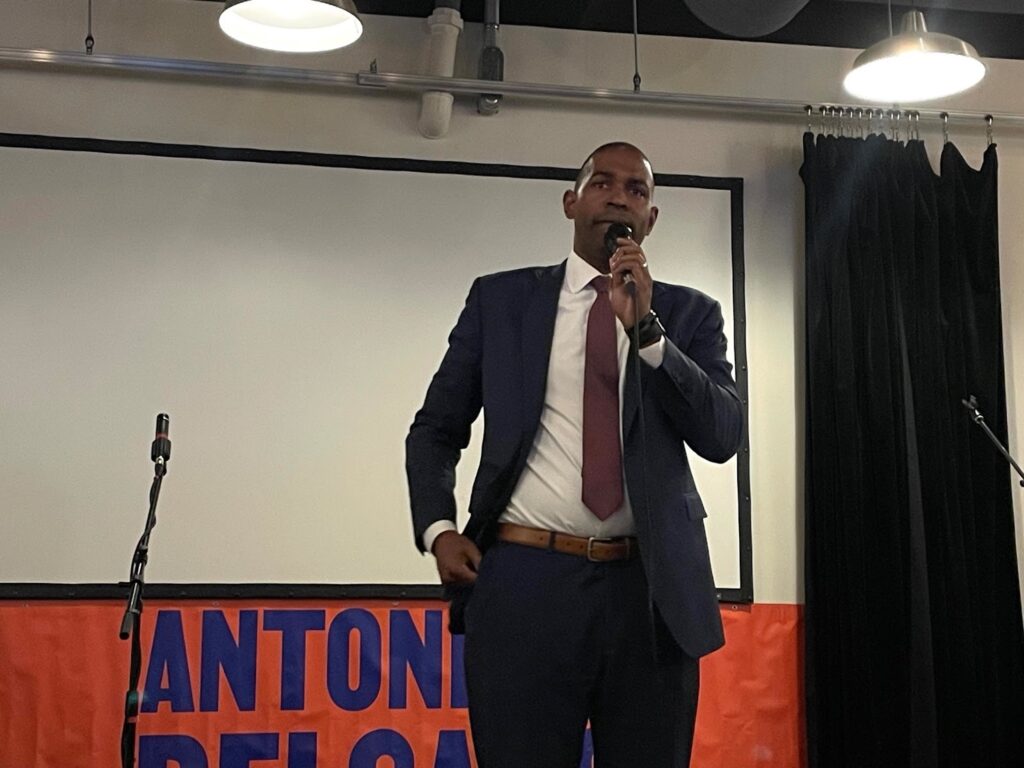
Lieutenant Governor Antonio Delgado visited Ithaca on Sunday, October 26, as part of his campaign for governor. Across two events—a campaign stop at Liquid State Brewing Company and a conversation with the Cornell Democrats in the Physical Sciences Building—Delgado outlined his vision for the future of New York: one focused on affordability, opportunity, and a renewed Democratic Party.
The lieutenant governor serves as a liaison between local, state, and federal partners to advocate for the governor’s priorities and initiatives, so Delgado’s gubernatorial campaign marks a striking challenge to Governor Kathy Hochul, who appointed him to his current position three years ago. His decision to run follows public disagreements with Hochul on national and state issues, including his call for President Biden to withdraw from the 2024 presidential race, his insistence for New York City Mayor Eric Adams to resign after his indictment on corruption charges, and the Hochul administration’s allegations that Delgado had failed to fulfill his responsibilities as lieutenant governor.
In Ithaca, Delgado used these tensions to argue that New York politics has become more about preserving power than serving people. He criticized what he described as a complacent Democratic establishment and said politicians in both parties have grown too focused on self-preservation to effectively serve their constituents. At Cornell, he reiterated that the government should serve people, not parties, and urged Democrats to hold each other accountable. He criticized Governor Hochul for failing to support candidates chosen by voters, referencing her hesitation to endorse New York City Mayor-Elect Zohran Mamdani after his resounding victory during the Democratic primary as a reflection of a deeper disconnect between party leadership and the people it represents.
Economic inequality was at the heart of his message. He pointed to the paradox of New York—one of the most Democratic states in the nation—still having one of the largest wealth gaps.
Delgado blamed this disparity, in part, on the misallocation of public dollars, criticizing the flow of state money toward corporations and developers rather than residents, arguing that public funds should serve the public good. He asserted that the current system of incentives for large companies has failed to produce long-term benefits for ordinary New Yorkers and instead widened the wealth divide. His campaign calls for redirecting those funds to support small businesses, family farms, and community-based programs intended to combat generational poverty.
Delgado also proposed policies to tackle the rising cost of living, including a statewide rental assistance program and grants for first-time homeowners. He has also called for a self-sustaining healthcare system and for raising wages for childcare workers as part of a broader plan for universal childcare. These reforms, he argued, would allow more families to stay in New York rather than being priced out of it.
Throughout his visit, Delgado positioned his campaign as both a critique of the current state leadership and a call for structural reform. His message in Ithaca centered on what he described as rebuilding the integrity of government institutions through affordability, transparency, and public investment.