
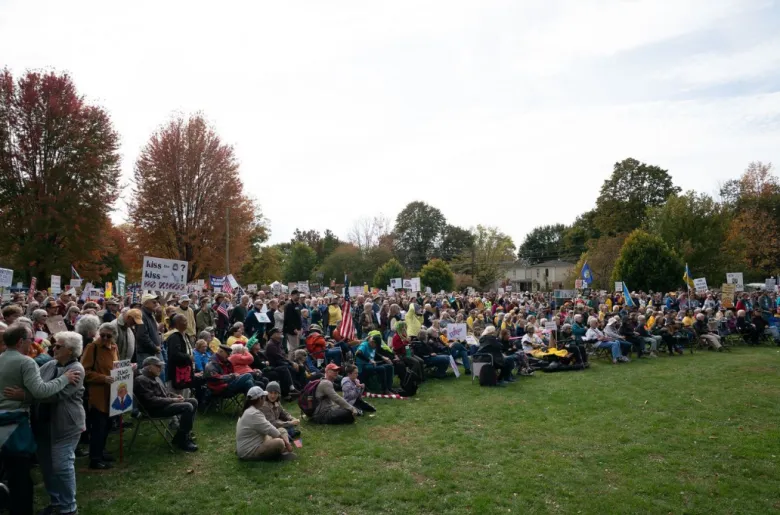
On October 18, an estimated seven million people organized together across the nation in cities large and small—from San Francisco, to Boston, to Ithaca—in a unifying rejection of the Trump administration. The numbers in attendance make it a contender to be one of the largest single-day, nation-wide protests in American history. The common protest calls were “No Kings” and “No Tyrants” in resistance to an authoritarian shift in the federal government.
Locally, thousands of protesters gathered in Washington Square Park in front of an erected stage that hosted speakers such as New York State Assemblymember Dr. Anna Kelles, Cornell professor Suman Seth, and Ithaca Mayor Robert Cantelmo.
Kelles, kicking off the rally, told the crowd, “It’s our responsibility, if we want to take back this country, from the fascist dictator that is currently sitting in the White House, to find the common ground with everyone we see.” Over the course of her speech she promoted various bills she’s working on concerning migrants, such as New York For All, which protects against random Immigration and Customs Enforcement (ICE) searches of people on the street, prohibits state and local government agencies from sharing someone’s immigration status, bars the transfer of individuals in New York State to immigration authorities, and forbids use of state and local resources for immigration enforcement. On this last aspect, Kelles remarked, “We will not use New York State’s taxpayer dollars to do the federal ICE’s jobs for them.” Further, she talked about the Access to Representation bill, ensuring anyone arrested by ICE has representation when prosecuted; “Individuals are eighty percent […] more likely to get deported if they don’t have representation,” Kelles continued, “they should get representation whether they can pay for it or not.” The pending bill, Dignity Not Detention, prohibits New York’s state and local governments from renewing or making contracts with ICE. Finally, the Build Act supports any non-profit striving to protect immigrants in their communities with funding to build up their workforce and execute their missions.
Suman Seth, vice-president of the local chapter of the American Association of University Professors, delivered a derisive yet hope-filled speech, describing the rally as “our second attempt to explain to a rancid and incompetent would-be king, that royalty don’t rule in a democracy.”
Seth then went on to explain some comparative “historical factoids”—as he put it—about dictators such as Napoleon and Kaiser Wilhelm II. He pointed out, “Emperors come and emperors go, but the people are always here.” Seth inspired the crowd to recognize the purpose of their gathering: resistance.
Volunteer organization Indivisible Tompkins, the most significant organizer of the event, was unable to put on the march they had planned, so instead interspersed musicians into the queue of speakers. The crowd heard inspiring anthems from local musicians, including Travis Knapp, Maddy Walsh & The Blind Spots, The Resisters Singers, and Mike Ciccone & Annie Burns. Travis Knapp engaged the crowd in a call-and-response song: “Show me what democracy looks like…this is what democracy looks like.”
After the performances and speakers, many rallyers broke off from the park and began circling the block with signs and chants, beginning a self-led march that weaved its way around the west side of downtown.