
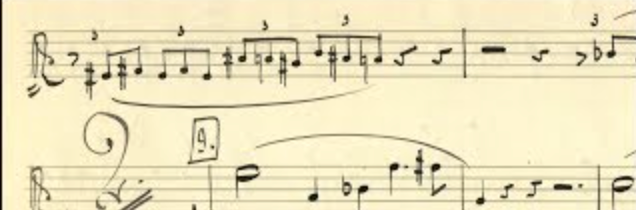
Following the discovery of a previously unknown Chopin waltz, we now delve into a lost chapter of early twentieth-century music: Igor Stravinsky’s Chant funèbre, also known as Funeral Song. It was composed in 1908 in tribute to his teacher, Nikolai Rimsky-Korsakov, and was thought to be lost for over a century. First performed in 1909 at the St. Petersburg Conservatory in Russia, it vanished as the country entered an era of revolution and turmoil.
During Stalin’s rule in the Soviet Union, artists were expected to follow strict government guidelines that promoted only positive depictions of Soviet life. Stalin, as a dictator, used censorship and propaganda to control culture. Music, art, and literature that did not align with his values were often banned. Because Igor Stravinsky had emigrated to the West after the Revolution and built his career in Europe and the United States, the Soviet government treated him as a political outsider. His name was erased from public life in Russia, his music was banned from performance, and he was officially labeled a “non-person”—someone who was to be ignored or forgotten by society.
Through the decades of war and political change, many works including Stravinsky’s had been scattered or lost. Stravinsky himself believed that Funeral Song had disappeared during the Revolution, along with many of his other works. In reality, the orchestral parts had quietly remained in Conservatory archives since 1932.
The long-lost parts came back to light in 2015, when a librarian, Irina Sidorenko, at the Conservatory was clearing out a storage room. Hidden beneath piles of old manuscripts, the pages were soon recognized by Professor Natalia Braginskaya as belonging to the Funeral Song. Realizing the historical importance of the find, she undertook the painstaking task of reconstructing the full score, guided by notes and markings from Stravinsky and the musicians who had played at the original premiere.
On December 2, 2016, more than a hundred years after it was last heard, conductor Valery Gergiev and the Mariinsky Theater Orchestra presented the revived work at the Year of Stravinsky Festival. The performance revealed the music’s deep emotional power—a solemn procession of sound written as a farewell to Rimsky-Korsakov. Funeral Song has since been performed by several renowned orchestras including the LA Philharmonic, Frankfurt Radio Symphony Orchestra, and Lucerne Festival Orchestra. Stravinsky once called Funeral Song his “best early work,” and, after more than a century of silence, its rediscovery reminds us that great music never truly disappears—it only waits to be found.