
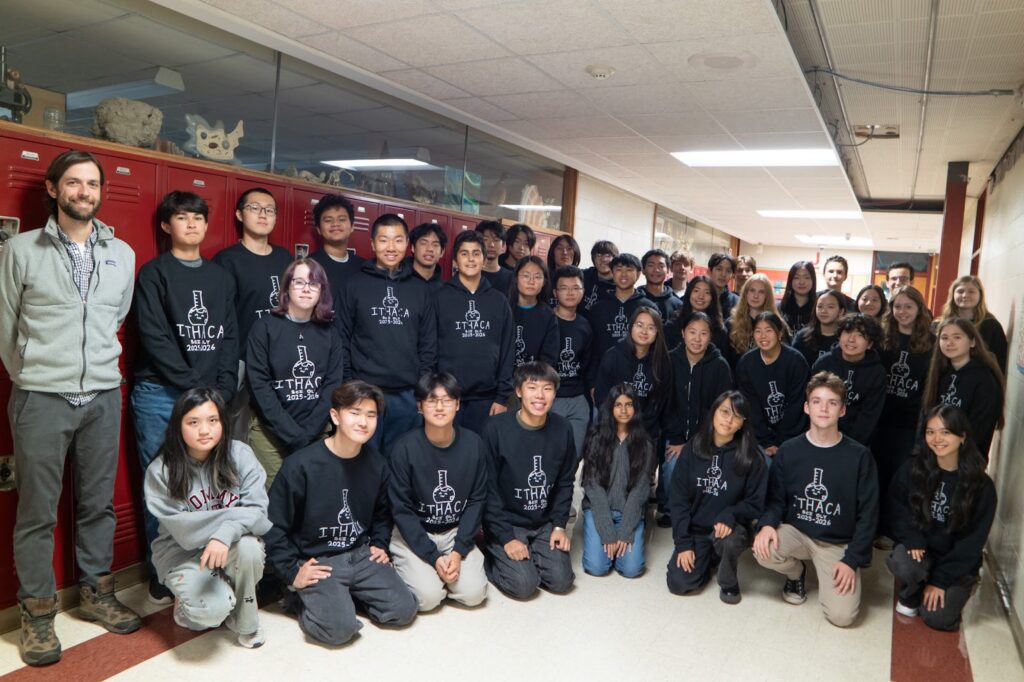
Every Monday after school, a group of students crowds into H104, gathering around a whiteboard as their officers deliver rousing remarks in preparation for upcoming events. This is Science Olympiad.
Science Olympiad—often called SciOly—competitions are divided into a series of events spanning a wide range of science and engineering disciplines, including biology, chemistry, physics, earth science, and astronomy. Each event emphasizes different skills: some require participants to design and build machines from scratch, while others focus on mastering specific scientific concepts through tests.
Many members cited this breadth as the primary reason they joined the club. Stephen Hur ’28 expressed his appreciation for “being able to indulge into fields that I would not otherwise study.” Luke Hwang ’27 noted that Science Olympiad differs significantly from other science competitions because “there are a lot more events to choose from,” adding that the collaborative nature of the competition style allows members to “build a lot of connections.” Andrew Gao ’26 echoed this sentiment, explaining that “it’s not necessarily like you’re learning science in a classroom,” but rather exploring “a lot of interesting topics that you don’t necessarily learn in school.”
Beyond personal interest, members emphasized the academic benefits of participating in Science Olympiad. Hwang explained that “you learn a lot in SciOly, and that applies to school, especially biology, chemistry, and physics classes.” Hur highlighted how CAD-based (computer-aided design) events helped him “touch up on [his] skills” for courses in the Project Lead the Way engineering pathway. Gao added that the club “teaches you how to self-study, forcing you to learn high-level topics,” a skill he credits with improving his performance in school. He also noted that Science Olympiad teaches resilience, explaining that “there are a lot of failures, and you have to learn to not be discouraged.”
Preparation plays a central role in the club’s success, with much of it taking place outside of weekly meetings. Ada Iyer ’27 described preparing through “a lot of studying,” while Hur shared that he relied on practice tests and problem sets, even reading textbooks to prepare for his genetics event. Benjamin You ’28 spends his time creating comprehensive packets of notes so that “anyone with no prior experience can see it and understand the topic.” Science Olympiad Captain Ethan He ’26 underlined the importance of these materials, noting that many packets are passed down across generations of members and have been essential to the club’s continued success. This preparation paid off at the club’s most recent competition, where IHS teams placed third and ninth, bringing home numerous medals.
Members also highlighted the strong sense of community within Science Olympiad, crediting mentorship from upperclassmen and alumni as a key factor in the club’s success. President Connie Zheng ’26 explained that officers intentionally group students to ensure that new members are supported by more experienced teammates, stressing that “all you need is interest” to join. Gao and Hwang both emphasized that everyone begins with little prior knowledge, encouraging new members to “not be afraid to ask for help.” Reflecting on their own experiences, they shared that while they initially struggled, “as the years go on, you just get better and better.” Their advice to prospective members was simple: “enjoy the club.”
The club is currently recruiting members for its regional competition, which will take place on February 28 at IHS. Officers described the event as a valuable opportunity for interested students to experience Science Olympiad firsthand and encouraged anyone curious to attend meetings—which take place on Mondays in H104—and participate.
Be First to Comment