
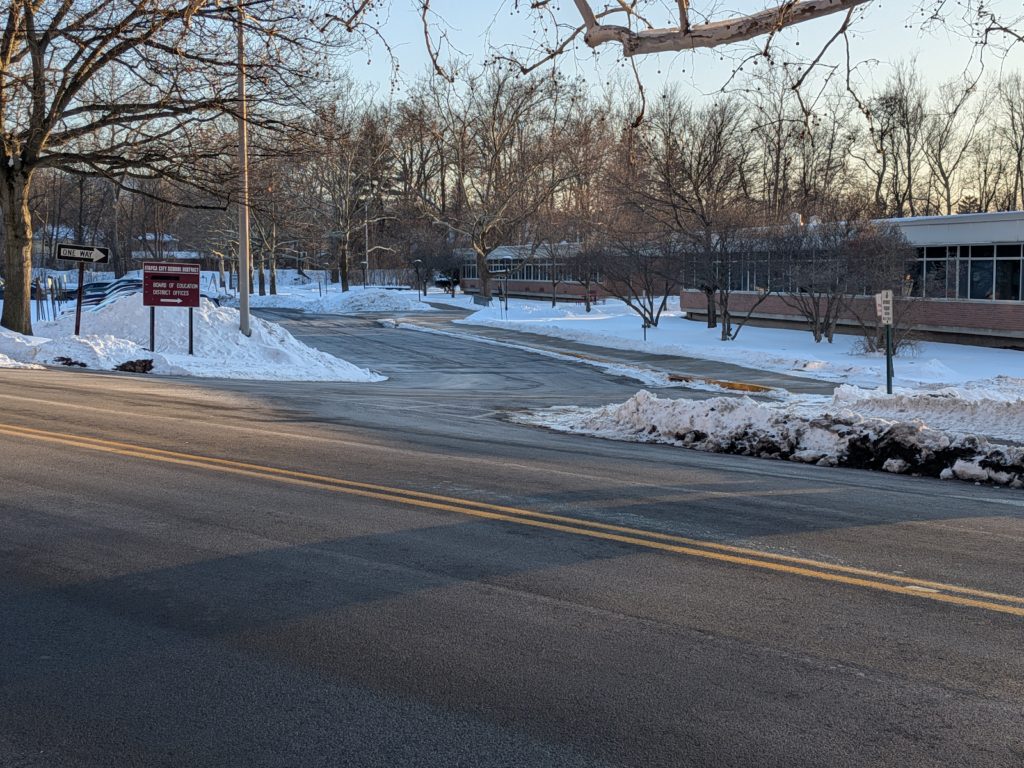
A Cornell study outlined the benefits of closing some of Ithaca’s elementary schools in the next decade. As the local population of school-age children decreases, closing school buildings could save ICSD millions of dollars every year, the study’s various alternatives show. ICSD does not have any plans to shut down schools at present.
Almost all of the eight elementary schools in the ICSD are a good margin below capacity, and most have a defined downward enrollment trajectory, according to the study produced by Cornell Population Center’s Program on Applied Demographics. The study, presented to the Board of Education (BoE) by Cornell professor Matthew Hall under commission from ICSD, argues that it is unsustainable for the district to continue to pay for the upkeep of facilities not being used to their full potential, saying, “a half-empty school building costs nearly as much to operate as a full one.” The study bases this on each building’s “fixed operating overhead that does not scale down with fewer students.” It also notes that many of ICSD’s facilities are legacy buildings and are, or will soon be, in need of costly capital improvement.
Scenarios in the study approximated annual savings of 1.6 to 2.8 million dollars if one elementary school were to close, 3.7 to 4.9 million dollars if two elementary schools were to close, and about 6.5 million dollars if three elementary buildings closed and middle schools were restructured, with all students in fifth and sixth grade housed in one school and seventh and eighth in another. The study added that a middle-grade reconfiguration “is a substantive program design choice with significant pedagogical implications,” and district leadership would have to be intentional upon implementation of such a change. Adjustments to Lehman Alternative Community School (LACS) were not directly discussed, as enrollment in the school is based on a lottery in which the same number of students are admitted each year.
Most schools are well below capacity, a calculation in the study shows. The study estimates each school’s total “proxy” capacity by dividing a potential number of students per classroom—eighteen for elementary, twenty-two for secondary—by the school’s total number of classrooms, some of which are currently out of use due to underenrollment. Belle Sherman has about eleven students per classroom; Enfield has fewer than seven. And projections in the study show further decline in coming years; in 2025, IHS had more than twenty-five students for each classroom, but even the most conservative projections place this value below twenty by 2035.
“Underlying the enrollment decline is a significant drop in local births,” the study writes. “There is a strong relationship between local fertility and kindergarten matriculation […] These smaller incoming classes will progressively move through the system and reduce total enrollment in upper grades in the coming years.” ICSD’s declining enrollment is not unique; school enrollment in New York has not been this low since the early 1950s. Although state funding often remains amid declining enrollment, sharp inflation means that funding does not adequately cover the needs of the district; often, local taxpayers ultimately take the burden. Plagued with similar issues, Mount Vernon City School District in Westchester County closed down three schools last July after being noted by a report from the Office of the New York State Comptroller as being in the worst financial state of any school district in the state.
Along with financial drawbacks of operating half-empty schools, there is a heightened per-capita environmental impact. State data from the 2022–23 school year gives each ICSD school an Energy Star rating: nine of Ithaca’s thirteen schools score under forty percent, so many schools are operating inefficiently by both capacity and energy metrics. IHS librarian and climate activist Armin Heurich said that environmental concerns should be considered only after it is clear that underprivileged neighborhoods are not disproportionately affected by school closings. “It’s my hope that if renovations or new construction [are] required as part of such efforts, building energy efficiency and efforts to decarbonize building HVAC systems will be considered,” Heurich says.
“I am optimistic that we can make great progress on reducing greenhouse gas emissions in the coming years through transitioning away from the use of fossil fuels, which will also result in more efficient systems which use less energy and ultimately reduce our operations costs over time. I’m aware of a number of school districts that are transitioning away from the use of fossil fuels and have moved to ground-based and air-based heat pump systems,” Heurich said. “These systems are very economical and efficient.”
In a press release, the BoE made clear that despite ongoing demographic research, there are “no active plans” to close or restructure schools. “If, in the future, the ICSD Board of Education were to consider the consolidation of any school(s),” the press release says, “there would be many public discussions informed by data the board has not yet conceptualized or requested, let alone collected as of the January 13 meeting.” BoE President Dr. Sean Bradwell stated in an email that currently, the district is not weighing specific school closures, and there is “no timeline for the closing of any school in the Ithaca City School District.”
Amid ongoing enrollment declines and trailing fiscal issues, school district leadership will need to weigh implications on students and staff as well as taxpayers while necessary decisions are made.
Be First to Comment