
While reading the section entitled “Culture in an Age of Reaction and Revolution” in my AP European History textbook, I came across the artistic and intellectual movement of Romanticism. I started thinking about how many of my favorite composers came from the Romantic era and how history still manages to “lose” so much music. That curiosity sent me down a rabbit hole as I began searching for rediscovered pieces, expecting to find big works like symphonies. Instead, I stumbled across something surprisingly small: a short song titled “Des Menschen Herz ist ein Schacht,” translated as “The Heart of Man Is Like a Mine.”
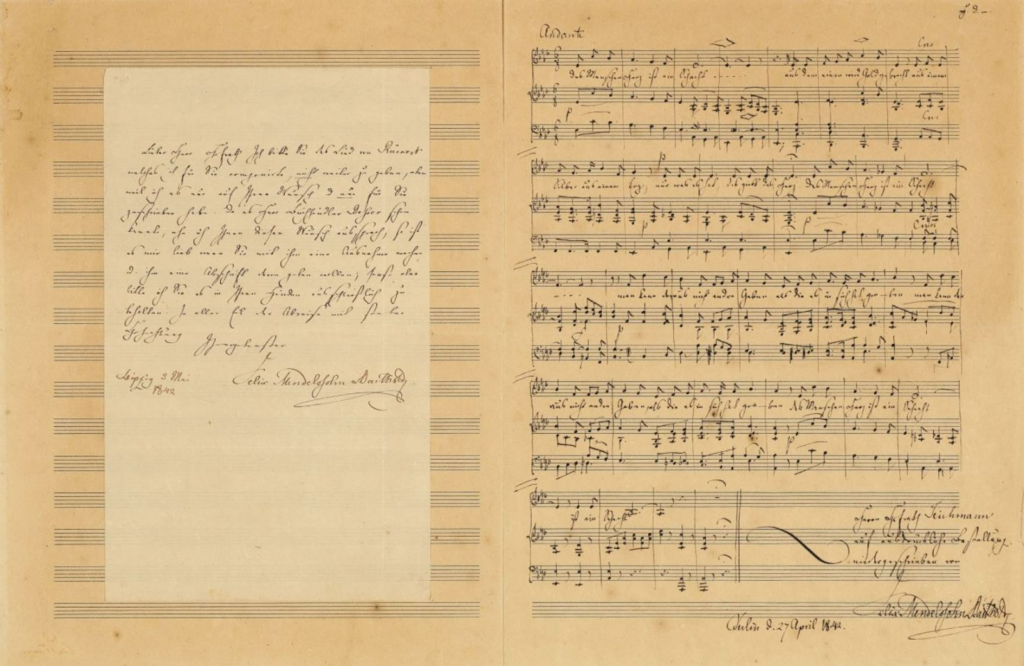
Mendelssohn composed the lied in 1844, when he was in his early thirties, and unlike works designed for publishers and public concert halls, this twenty-nine–bar commission was never meant to circulate widely. It sets text by poet Friedrich Rückert and was written as a gift for Johann Valentin Teichmann, a figure in Berlin’s musical world who managed the Royal Theater and even lived with the Mendelssohn family for a time.
That private origin helps explain why the song disappeared so easily. Unlike rediscovered works that were lost due to war damage, censorship, or being buried in an archive under the wrong name, Mendelssohn’s song faded because it wasn’t widely circulated in the first place. The signed manuscript changed hands through auctions, including histories of sales in 1862 and 1872 but then it vanished from the historical record.
The story of its disappearance reflects the larger forces that shaped which composers were celebrated and which were pushed aside after their deaths. Mendelssohn’s reputation suffered because of rising antisemitism in nineteenth-century Europe. Not long after Mendelssohn died at age thirty-eight, figures like Richard Wagner attacked him in writings such as “Judaism in Music,” using antisemitic rhetoric to argue that Jewish artists had no place in “true” German art. Even when this kind of argument was morally bankrupt, it still influenced public opinion and helped make it easier for Mendelssohn’s work to be scattered and treated as not worthy of preservation.
Then, in the twentieth century, politics interfered with preservation even more directly. As the Nazi regime rose to power, Mendelssohn, who had been born Jewish even though his family converted to Christianity, became a target of cultural erasure. Manuscripts that had been held in Berlin were disrupted and displaced; large collections were moved out of Germany, sent to places like Warsaw and Kraków, and later dispersed as Europe descended into war. In the political chaos, musical artifacts were scattered across borders, institutions, and other private collections.
That is exactly how “The Heart of Man Is Like a Mine” reappeared. In 2014, the manuscript was rediscovered in the United States among the papers of a Mendelssohn enthusiast after about 140 years of silence. Alongside it was a letter from Mendelssohn to Teichmann making it clear the song had been written for him alone, almost as if Mendelssohn was trying to keep it from becoming public in the first place. Despite the letter, the modern premier was performed on May 6, 2014. The song received what was described as its first public hearing since it went missing, performed on the BBC Radio 4 “Today” programme by mezzo-soprano Amy Williamson and pianist Christopher Glynn, both connected with the Royal College of Music.
In the end, “The Heart of Man Is Like a Mine” reminds us that history is shaped by what survives, what gets archived, and what prejudice or politics tries to erase. More than a century after it slipped out of view, Mendelssohn’s rediscovered lied offers listeners proof that even familiar composers can still surprise us.
Be First to Comment