
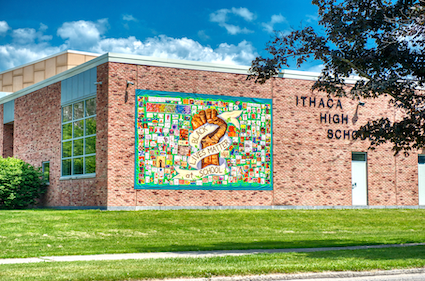
When I came to IHS in ninth grade, the school community was wrestling with the inequities exposed by COVID-19 and white America’s so-called “racial awakening” following George Floyd’s murder. These issues were far from resolved, but there was a clear path toward progress: students were engaging in discussions of racial justice in classrooms across disciplines; clubs like I-RISE, Beauty of Color, and Afro-Latino club were beacons of student leadership and advocacy; and students, staff, and administrators were working together in so-called Restorative Justice Circles to reimagine how ICSD approaches student discipline.
Three years later, IHS no longer has a single racial-justice centered club. The Restorative Justice Circles and Students of Color United Summit, after legal challenges from the Trump administration, have been “discontinued.” The percentage of Black students in our district subjected to long-term suspensions has jumped from roughly seven percent in 2022 to roughly fourteen percent in 2025. For comparison, just under three percent of white students were suspended in 2025. To make matters worse, students recently received an email saying that, as part of a campaign against distracted driving, we can expect to see “more police presence around campus.”
This is not to say that there are no dedicated students, staff, and community members advocating for progress; IHS is lucky to be home to an Indigenous Studies and an African American Studies course, both the result of teacher advocacy. Programs like My Brother’s Keeper, Village at Ithaca, and the Cornell Science and Technology Entry Program have not wavered in their support of marginalized youth in our communities. At LACS, student-led Infusion Week this March centered Latinx voices in art, literature, and activism.
District leaders, on the other hand, have continued overusing the word “equity” while “phasing out” of solidarity. This is evidenced by the shutdown of the Students of Color United Summit, the discontinuation of restorative justice circles, and fall back on police, long-term suspensions, and student surveillance.
I recently watched the Village at Ithaca Youth Board’s interview of Board of Education candidates, which can be found on the Ithaca Public Education Initiative’s YouTube account. Student leaders asked why suspensions are increasing and disproportionately targeting Black and Hispanic students. They said they feel unsafe and marginalized by ICSD and asked what the BoE candidates plan to do about this. They asked how the Board should react to the changing national political landscape.
The candidates seemed caught off guard by these questions, but they said all the right things: suspensions are bad for student learning; the gap between policy and implementation needs to be closed; and ICSD will stand by its commitment to equity.
My parting question for the IHS community is this: will we hold them accountable?