This year’s June primaries have attracted widespread attention to New York across the nation because of close and competitive races in the state. Here in Ithaca, we had primaries for the Ithaca Common Council and Tompkins County legislature, which saw no major changes for Ithaca politics but did see wins for socialist candidates. Another major development from this year’s primaries was the unexpected victory of former state assemblyman Zohran Mamdani in New York City’s Democratic mayoral primary.
Here in Ithaca, voters chose new representatives for both the City of Ithaca’s Common Council and the Tompkins County Legislature. These bodies make decisions on issues such as housing, transportation, and climate policy.
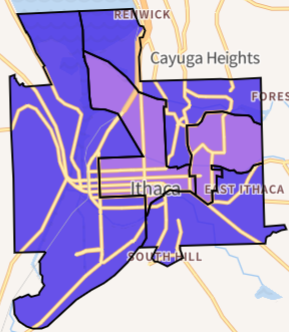
The Common Council has ten members, with two members from each of the five wards. Elections are staggered, so voters elect one Council member per ward every two years. Wards 2 and 4 weren’t competitive, and the Democrats running there, Joe Kirby and Robin Trumble, won easily. In Ward 1, Democratic Socialist Jorge DeFendini won the three-way Democratic primary; he will face off against Republican Zachary Winn in the general election on November 4. Ward 3 saw Democrat Patrick Sewell win after falling short in 2023. In Ward 5, after a very close race and a recount, Hannah Shvets ’24, a Cornell undergraduate, Democratic Socialist, and former Tattler editor, won the Democratic nomination. One of Shvets’s opponents in the primary, G.P. Zurenda Jr., will be running again in the general election on the “Affordable Ithaca” party line he created.
The Tompkins County Legislature also held elections this year, as it does every four years. During this election cycle, the legislature expanded from fourteen to sixteen members due to redistricting.
Only two districts had contested primaries. In District 3, Iris Packman defeated Pierre Saint-Perez. In District 13, Irene Weiser won a three-way race against current IHS social studies teacher Kyle Emily Erickson and Matt Sullivan. Both winning candidates are endorsed by the Working Families Party. District 8 is the only one expected to have an opponent in the general election this fall, between Democrat Jamie Perkins and Republican incumbent Mike Sigler.
The outcome of the District 8 race will determine whether Democrats hold thirteen or fourteen of the sixteen seats in the Legislature. Either way, Democrats remain in strong control, with gains compared to the last cycle.
A notable trend this year is the continued rise of socialist and progressive candidates in Ithaca politics. If Jorge DeFendini and Hannah Shvets win in the general election, the number of Common Council members affiliated with the Democratic Socialists of America (DSA) will grow to three out of ten. Furthermore, the Working Families Party, a progressive party line that supports labor rights, housing reform, and climate action, had most of the people they endorsed win. Depending on whether Shvets wins or not, five or six out of the ten people on the Common Council, and nine out of sixteen on the Tompkins County legislature, will have been endorsed by the Working Families Party. Shvets and Zurenda’s race will determine the strength of the progressive bloc in Ithaca.
On the state level, one of the most surprising results was the win for Democratic Socialist Zohran Mamdani in New York City’s Democratic mayoral primary.
This year’s primary saw eleven Democratic candidates, with the most prominent being Mamdani and former New York Governor Andrew Cuomo. Early in the race, Cuomo appeared to have a commanding lead. However, Mamdani’s extensive campaign operation, public outreach, and growing social media influence helped him close the gap.
New York City recently implemented ranked-choice voting for local elections, in which voters rank up to five candidates in order of preference. The winner is determined in a process that eliminates the candidates with the lowest percentage of the vote and redistributes their votes to the next choice candidate until one person has more than fifty percent of the vote. Mamdani won the first round of voting with 43.8 percent to Cuomo’s 36.1 percent, effectively securing his place as the nominee. In the final round of ranked-choice voting, Mamdani increased his margin, winning with 56 percent to Cuomo’s 44 percent.
It’s important to note that while New York City has a strong Democratic majority, the race isn’t over. Curtis Sliwa will run as the Republican nominee, and both Andrew Cuomo and current mayor Eric Adams plan to run as independents. The next mayor will be determined in this fall’s general election. According to recent reports, President Donald Trump has privately suggested he may try to influence the race to prevent Mamdani from winning. In a press conference on August 7, Mamdani responded to this by vowing to be Trump’s “worst nightmare.”
Overall, both locally and statewide, there is a clear shift toward socialist and progressive candidates. This trend suggests that New York, especially areas like Ithaca, may see continued implementation of progressive policies in the coming years.