Author’s note: This article was written in early March and may not accurately reflect the status of the war when published.
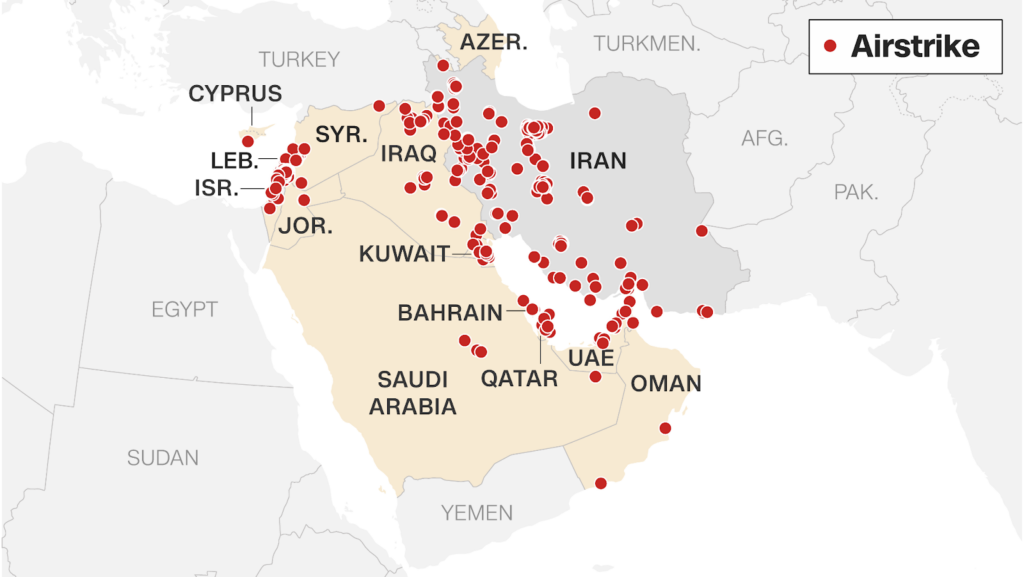
On February 28, the United States and Israel announced a joint military operation in Iran with a series of missile strikes that killed Ayatollah Ali Khamenei, the second supreme leader of Iran. He was succeeded by his son Mojtaba Khamenei. These actions caused the death of around 1,300 Iranians as reported by Iranian state media. America’s goals in this war are not yet fully clear. However, the consequences of this war on even a local scale can be felt and it is important to know how this conflict can or does affect us.
In the months leading to this war, tensions have been rising between the United States and its allies against Iran, with a conflict breaking out between Israel and Iran on June 13 now dubbed the Twelve Day War. Evidence shows Israeli Prime Minister Benjamin Netanyahu and Trump have been conferring about potential strikes in Iran since December. On the day of the attack, President Trump and military leaders launched the assault without consulting Congress, in which a war powers vote was quickly held in the house and rejected 212 to 219. Although the attack came as a surprise when it happened, geopolitical tensions have reached a breaking point.
This war continues the trend of American intervention in the Middle East since 9/11. There are many similarities between the War on Terror and the current Iran war. For example, President George W. Bush’s main goals in Iraq was to locate and destroy terrorist organizations, and to protect Americans from said organizations. This was his main reason to invade Iraq and capture Saddam Hussein, whom he claimed was designing weapons of mass destruction and collaborating with terrorists. Similarly, President Donald Trump has voiced for years that he has viewed the current government in Iran as a terrorist organization, and even designated the Islamic Revolutionary Guard Corps, Iran’s primary military branch, as a terrorist organization. Trump claims that Iran’s nuclear program will be used for weapons of mass destruction as well. The Iraqi war saw a land invasion as the way to remove Saddam Hussein and establish a new government. A land invasion has not happened in Iran, but not ruled out, with President Trump stating it’s “on the table.” Trump has repeatedly called for regime change.
The effects of this war can be felt all around the world. One of the most major is the sharp rise in gas prices. Here in Ithaca, gas has been rising in cost by almost 10 cents a day with most gas stations charging between 3.40 and 3.60 dollars a gallon. Many estimates suggest that the cost will rise to a 4 dollar average by the end of this week. This change is because of the agreement to avoid the Strait of Hormuz, which disrupts the gas trade, and essentially the cut off of Iran from selling its gas at all, as Israeli and American strikes have struck roughly thirty oil depots and facilities according to many news outlets such as Axios based in Atlanta, and Al Jazeera based in Doha, Qatar. If this rate keeps up, there could potentially be a rise in food prices as natural gas is used to make fertilizer.
The current administration has claimed a quick end to this conflict is near, but has admitted more conflict over the next month is also possible. In the meantime, Ithacans can expect gas rises to stay high.