
What do you do when you have a city that is behind on its sustainability targets and an overcrowded grid with rising energy costs for consumers? That’s the question the City and Town of Ithaca have faced recently in a period of stalled progress on climate goals as well as mounting inflation.
A partnership between the Massachusetts-based Local Power LLC and the Town and City of Ithaca is the latest effort to move forward what have become idle sustainability plans. Two new energy programs, marketed under the name Tompkins Green Energy Network (T-GEN), aim to bring clean energy options to Tompkins County residents by the fall of 2026.
One program, called Community Choice Aggregation (CCA), will lower energy prices for customers and increase renewable energy sourcing, while another, dubbed Own Your Power, will reduce reliance on the grid altogether by assisting individuals or groups of neighbors in procuring and operating onsite renewable energy systems.
The two new programs, which were developed from scratch by Local Power for the Ithaca market, are substantially different from each other. CCA—which will be implemented for most Town and City residents by default with an option to opt-out—essentially makes renewable energy elsewhere, while residents continue to receive power from the grid, without changing the mix of power supply locally. It is a cheap and reliable solution, according to Local Power President Paul Fenn, but fails to solve some of the underlying issues regarding energy reliance. “The way that it is designated as renewable is essentially legal. It’s a legal term. It doesn’t mean that it’s physically renewable,” Fenn said. “I can say that I’m one hundred percent renewable, even though the power that I’m buying is just from regular power plants […] We’re trying to get out of this—essentially, a cage that prevents climate action.” Fenn says that CCA is an attractive option for consumers that is intended as a first step toward getting to the Own Your Power model.
Local Power’s Own Your Power model is flexible and individualized. It will use technologies like solar panels as well as systems with an “energy storage capacity” that residents may already have—such as electric car batteries and home heating systems—to significantly reduce reliance on the grid, creating local, legitimately sustainable energy for homeowners who opt in. It will also allow neighbors to spread the cost of buying new equipment. “They’re not just local, they’re not just renewable, but they’re owned by the user,” Fenn says. After upfront costs are paid, he says, Own Your Power users will eventually have significantly lower energy costs than they would if they relied primarily on the grid.
Detaching from the grid is a logical choice, says Fenn. Doing so separates individuals from a stressed grid and fluctuating costs because of political tensions regarding trade of energy resources. Fenn says breaking off from the grid will “make energy less dangerous, less volatile, less unpredictable, […] and more democratic.”
Fenn says the changes are a big shift from the way energy has traditionally been procured: “Energy has just mostly been under control of financial institutions for over a century. There’s a lot of desire for [change], but there’s also a lot of things in the way,” he said. Fenn says local governments will need to break away from ideas about what their scope is. “Right now its mission is schools, police, road repair, sewer,” Fenn said.
It’s been seven years since the City of Ithaca passed the Ithaca Green New Deal (IGND), and six since the Town of Ithaca passed its Green New Deal. These resolutions made grand promises, but officials say a number of factors have pushed them off course over the past few years. The City could not reach its 2025 goal for carbon reduction locally, and instead purchased carbon “credits” to offset Ithaca carbon use by creating renewable energy elsewhere.
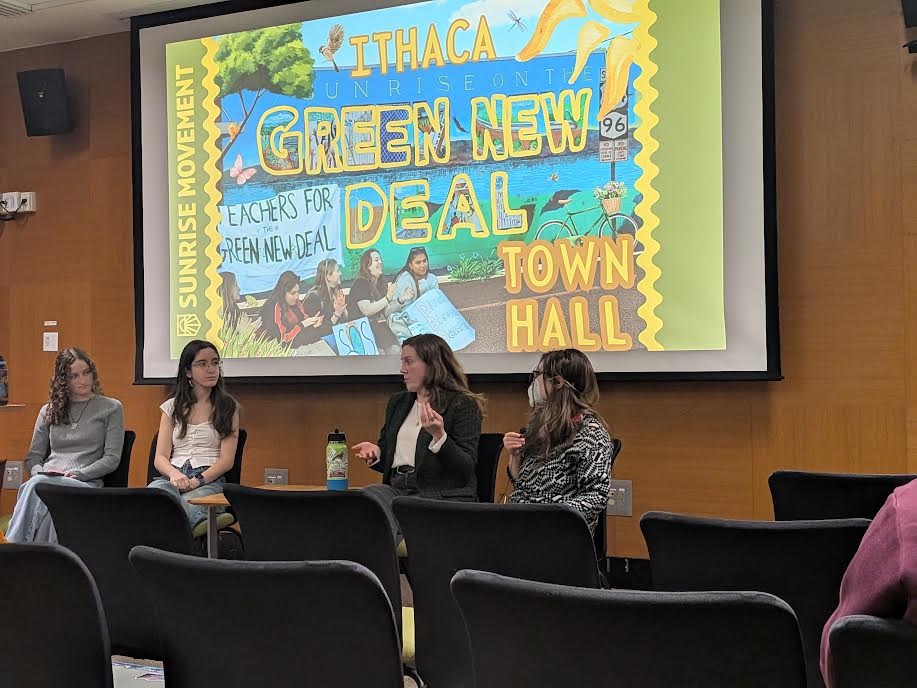
Initial plans for both the Town and City’s Green New Deals were overoptimistic, leaders admit. The Town of Ithaca, as part of a vehicle electrification project, would have electrified the Town fleet of dump trucks, but come time for implementation, officials realized that such a truck simply did not exist. “You can’t turn those vehicles around and make them electric,” said Town of Ithaca Sustainability Planner Hillary Swartwood at a March Green New Deal Town Hall led by the Cornell chapter of the Sunrise Movement, a youth climate justice organization. This is an example of how many plans were made without considering actual implementation.
Budgets for the City’s Green New Deal did not match expectations—in part because of larger-scale issues like the Trump administration funding cuts to green policy—leading to the need for a complete overhaul of the IGND’s guiding Climate Action Plan that took over a year to complete. A major contributor was the freezing of 1.5 million dollars in IGND funds by the Trump administration, which accounted for eighty-five percent of its budget before the lapse. Swartwood said new Town of Ithaca Climate Action Plans have been simple and clear, so as to avoid time wasted on planning with limited staffing: the Town’s sustainability office has only one employee, and the City’s has just two.
“Sometimes there’s a disconnect between what lawmakers pass and what is actually happening within a community, which can be frustrating,” said Swartwood at the Town Hall event, referring to misaligned policies at the federal, state, and municipal levels. Swartwood noted that new progress with T-GEN is “very exciting,” and says she is hopeful it will breathe new life into the idled Green New Deals.
A previous program of the IGND had Brooklyn-based startup BlocPower as a key piece of a plan to electrify Ithaca buildings citywide. But before the initiative could be completed, the company exited its partnership with the City after electrifying only a fraction of the buildings it was expected to. This has created a lasting sense of caution from residents and activists in regard to partnership with outside private organizations—and has led to a focus on action items achievable more locally.
Activists and officials highlight community involvement as a key part in advancing Ithaca’s sustainability programs. Tompkins-Cortland Community College student and Sunrise Ithaca activist Zach Schmitt said at the town hall that “the more of us [Sunrise Ithaca] got involved, the more we were able to make an impact.” The activist group pushed for the implementation of Justice50, a City program that prioritizes the populations most impacted by climate change when implementing solutions.
Collaboration in the community is at the heart of T-GEN’s Own Your Power initiative, which is designed for neighbors to come together to invest in an environmentally sustainable energy source. Both of T-GEN’s programs leverage economies of scale to make eco solutions viable and attractive to the many. More information can be found at www.tompkins-gen.com.
“If we just step up together, we can get so much done,” said Schmitt.