
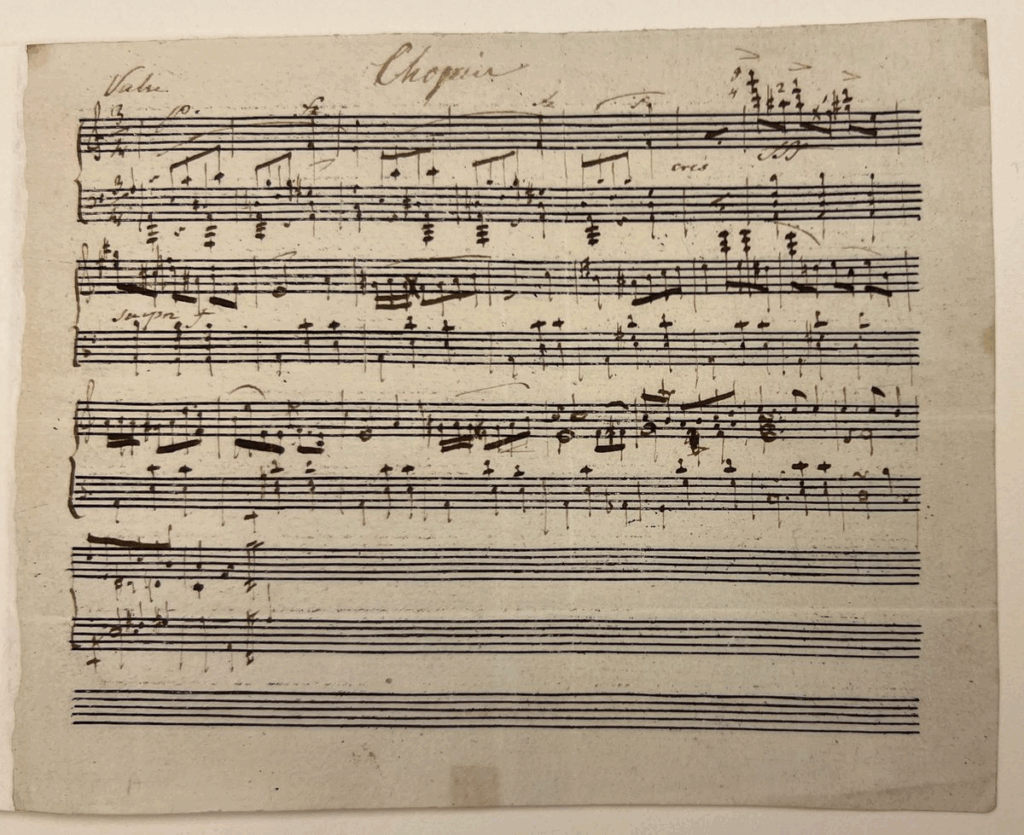
After exploring Mozart’s youthful Serenade in C Major, K. 648, we now turn to a rediscovery that sent ripples through the classical world last year: a previously unknown waltz attributed to Frédéric Chopin. Found last year, at the Morgan Library & Museum in New York, this small manuscript which was no larger than an index card, offers a glimpse into Chopin’s poetic imagination.
The fragment, written in A minor, surfaced during a project by curator Robinson McClellan. At first, it appeared to be an unassuming sheet of nineteenth-century music paper, named “Valse,” also known as a Waltz. However, after a closer examination, the handwriting and musical phrasing they discovered was remarkably similar to Chopin’s. Experts, including Jeffrey Kallberg of the University of Pennsylvania, authenticated the notation as genuine, though they noted that the word “Chopin” at the top was written by someone else, deepening the mystery surrounding the find.
Believed to date from around 1830 to 1834, the short waltz is only twenty-four measures long and unfolds in around a minute. As Lang Lang, a world renowned pianist who released the world premier of the Waltz with the prestigous record label Deutsche Grammophon, described, “It sounds very much like Chopin, with a very dramatic darkness turning into a positive thing. It’s beautiful.” Its wistful melody, delicate turns, and subtle rhythmic grace echo the salon intimacy that defined the style of Chopin’s Parisian years. The fragment encapsulates his unmistakable touch: elegant, melancholic, and harmonically daring.
The discovery marks the first newly authenticated Chopin manuscript in nearly a century, reminding us how even the most studied composers can still give us surprises! Several experts are with the opinion that Chopin wrote twenty-eight waltzes in total before he died. Seventeen waltzes were published before and therefore it is presumed that if more existed, they have since been lost or destroyed.
Meanwhile, some scholars maintain that the work may just be a draft of a later composition rather than a final waltz; the unfinished character of one of the most introspective voices in music is exactly the reason why it is beautiful. The rediscovered waltz of Chopin as compared to the lost serenade of Mozart conveys the endless depth of the past that is still able to be heard revived across the ages.