

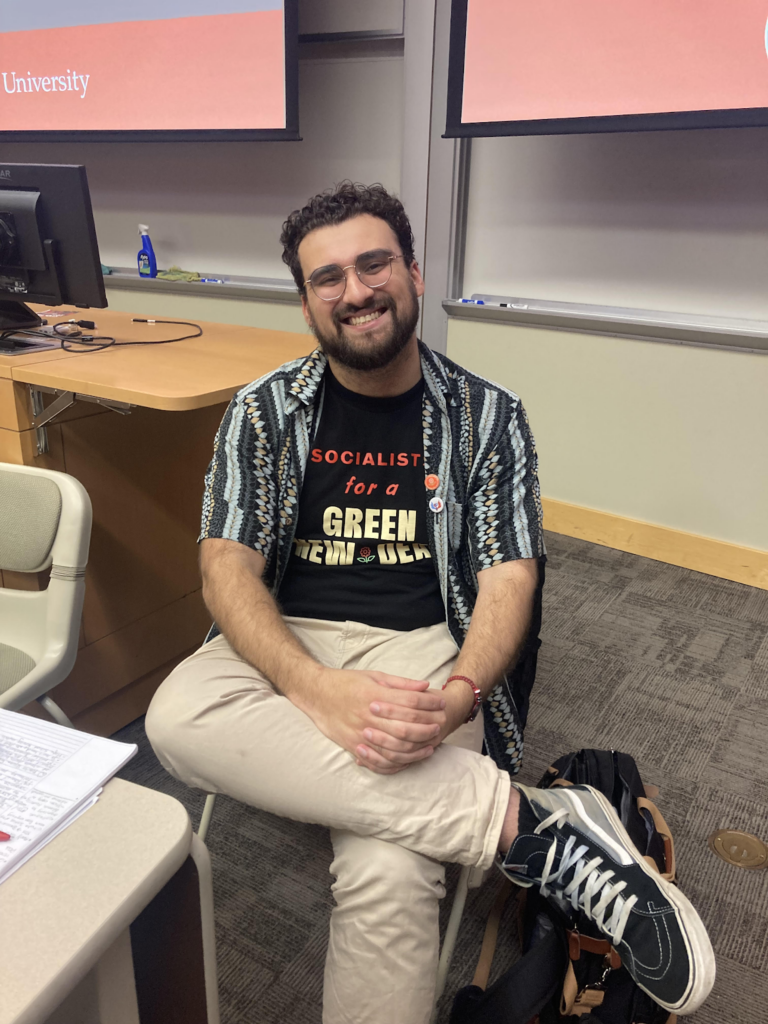
This November, two young democratic socialist candidates won their elections for Ithaca Common Council: Jorge DeFendini and Hannah Shvets ’23. Just ahead of the election, the two spoke at a town hall about local climate justice, emphasizing housing affordability, economic stability, and labor justice in their statements.
The Climate Justice Town Hall included a panel discussion and audience questions. Around twenty people attended the town hall, which was sponsored by local organizations Sunrise Ithaca, Sunrise Cornell, Cornell on Fire, and Cornell Progressives.
Each of the two candidates introduced themselves and shared their thoughts on how local communities are affected by climate change, the biggest climate challenge Ithacans are facing, and how they planned to help solve these issues if elected.
The first speaker was Jorge DeFendini, a Democrat, who won a four-year term on the Ithaca Common Council in the November 4 election. DeFendini will represent Ithaca’s First Ward, which includes Ithaca’s Northside, Southside, West End, and West Hill neighborhoods. A twenty-five-year-old Puerto Rican who grew up in Queens, DeFendini previously served on the Common Council from 2021 to 2023.
The other legislator at the town hall, Hannah Shvets, is a current third-year undergraduate student studying International Labor Relations at Cornell University. Shvets, a Democrat, was elected to the Ithaca Common Council on November 4 to represent Ithaca’s Fifth Ward, which includes the Cornell Heights neighborhood and parts of the Cornell campus. Shvets has lived in Ithaca since 2016 and attended IHS (where she served on the Tattler Editorial Board for three years). “Growing up here, I felt how every summer got warmer and warmer and flooding becoming more and more of an issue,” she said.
For both DeFendini and Shvets, affordability and sustainability are the backbone of their climate policy.
The downtown region that DeFendini represents is disproportionately affected by flooding due to its location. According to DeFendini, many people are being priced out of the First Ward because “they can’t afford to live in a climate catastrophe zone where flooding can be a real reality.”
DeFendini emphasizes economic sustainability as part of his climate policy, especially in terms of housing affordability. “If you’re a working-class Ithacan who can’t afford to live in Ithaca much longer because of the rent getting out of control, then this hasn’t been a very sustainable community for you,” he said. “And if we’re going to work on doing the organizing to make sure that we meet our goals, we have to have a stable community.”
DeFendini hopes to strike a balance between affordability and achieving sustainability goals. “We have to make sure that affordability is sustainable so that the apartments that you can live in that are sustainable are also quality apartments because they’re in line with our codes,” he said. To meet these goals, he brought up the possibility of passing legislation that would require landlords to allow tenants to install air conditioning units in apartments.
Shvets’s climate goals align with many of DeFendini’s plans for affordability and stability, and also emphasize labor justice and public transportation. “My goal for addressing climate justice in my campaign is through a labor lens, especially working with workers who are most impacted by climate change,” she said. She aims to ensure adequate pay, mandatory breaks, and safe working conditions for those working in high temperatures.
Shvets also plans to develop the green energy workforce in Ithaca, having previously collaborated with local labor unions on the renewable energy transition. To address concerns about job loss among workers in the fossil fuel industry, she aims to retrain these workers to transition into clean energy jobs. “A common concern of theirs is what will happen to workers who work in gas and mining, and how can we help them feed their families while transitioning to clean energy,” she said. “And the thing is, clean energy and labor, they don’t have to be opposing. They can be paired together.”
Public transportation is another key pillar of Shvets’s platform, particularly the Tompkins Consolidated Area Transit (TCAT) bus system. “We have a real lack of public transportation, and Cornell especially has been neglecting funding TCAT, which means we have a very car-centric city,” she said. “That’s something that I’m going to be fighting for, getting additional funding for TCAT, moving away from really high parking requirements that make it harder to build dense housing.” In doing so, Shvets plans on working closely with the TCAT workers’ union to ensure a fair contract.
Both DeFendini and Shvets plan to work with community groups like Sunrise Ithaca to push for more progress with the Ithaca Green New Deal, a local initiative to ensure carbon neutrality and sustainability in the community. Shvets believes that the deal has not received enough funding or attention and emphasized the need for urgency. “We are not actually moving towards sustainability in this city,” she said. “The Ithaca Green New Deal has been discussed for several years and has not received the funding that it needs or the attention that it needs […] but it’s becoming more of a crisis and reaching a point where we will not be able to return.”
Finally, both DeFendini and Shvets emphasized that community collaboration is essential for effective climate policy and action. Shvets hopes to rally different groups in the community, including students, local residents, and homeowners, to take a united stance on climate action. “[We] have often been divided and believe that we have different goals and we’re not all fighting for the same things,” she said. “But in reality, we all want a cleaner Ithaca.”
DeFendini echoed this sentiment, stating that climate action must be collaborative. “There’s nothing special about me, a twenty-five-year-old who just got his driver’s license a month ago, who’s going to crack the code for how we do sustainability in our city,” he said. “We believe as organizers, as democratic socialists, as climate activists, in co-governance, that we’re going to be working with you all to pass this legislation.”