
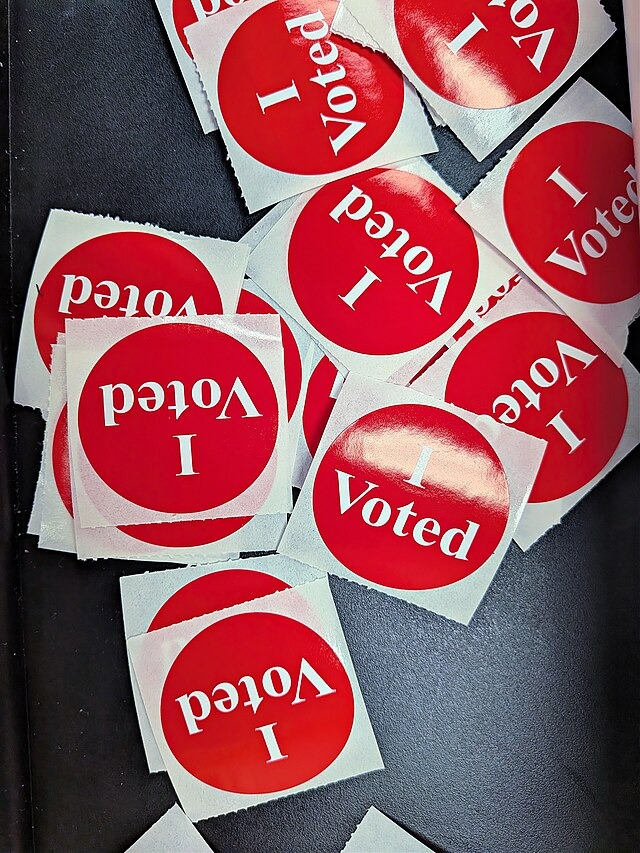
Democrats scored victories in elections across America on November 4, providing much-needed energy to a party staggering after President Trump’s win last year. Locally, the election saw Democrats take spots in Common Council and Town of Ithaca elections. Nationally, Democrats dominated key races, giving the party a sense of hope entering the second year of President Trump’s presidential term. Voters are known to often skip the polls or put less thought into their decisions during off-year elections like this one. Still, individuals’ participation in local elections actually holds more of an impact than in larger ones: turnout in small neighborhood elections is often only a few hundred votes.
In Ithaca’s Common Council, Democrats swept, taking up all available spots. Democratic socialist Jorge Defendini took Ward 1 with just under eighty-nine percent of votes, beating anti-crime Republican Zachary Winn. In Wards 2, 3, and 4, uncontested Democrats Joe Kirby, Patrick Sewell, and Robin Trumble won respectively, all with almost one hundred percent of the vote. Perhaps the most interesting result in Ithaca came in the Common Council election for the city’s Fifth Ward, representing parts of Cornell campus, Fall Creek, and Cornell Heights. In the Democratic Primary, Tattler alumna, Cornell Junior, and democratic socialist Hannah Shvets ’23 ran against longtime Ithacan G.P. Zurenda Jr. and Deborah Fisher. Shvets won the primary by a substantial margin, with Zurenda coming in second. Subsequently, Zurenda announced a new campaign for election in the race under his own “Affordable Ithaca” independent ballot line, while Fisher endorsed Shvets. Shvets won the election day race, mirroring this ward’s last election, where Cornell undergrad Clyde Lederman beat Ithacan Jason Houghton in the Democratic primary, and later in the general election. In retrospect, Lederman told the Ithaca Voice that despite his successful tenure in office, the role was too much on top of his existing pressures as a student. According to The Voice, Lederman advised students to “be very cautious” if considering running for office.
In the Town of Ithaca’s municipal elections, Democrats were uncontested and took all spots—three town councilperson roles: Rob Rosen, Diana Sinton, and David McCune—and one town justice role, Jim Salk. Tompkins County Legislature positions leaned mostly democratic, but certain areas, such as Groton, had high concentrations of Republican representatives.
Local elections might be seen as a small-scale representation of a nationwide “blue wave” after Trump took office earlier this year. Democratic socialist and democratic nominee Zohran Mamdani won the seat for Mayor of New York City, democrat Mikie Sherrill became the governor of New Jersey, and Abigail Spanberger won the race for governor of Virginia.
Mamdani was born in Uganda and moved to the Big Apple at age seven. Mamdani graduated from New York’s Bronx High School of Science and later Bowdoin College, where he received a Bachelor’s Degree in Africana Studies. In 2018, he received United States citizenship. Mamdani worked as a foreclosure prevention counselor, helping Queens’s low-income residents stay housed, and then as a New York State assemblyman. Mamdani plans to make NYC more affordable by prioritizing renters, adding city-owned food markets to curb high grocery costs, and eliminating fares on local buses.
Sherrill currently represents New Jersey’s Eleventh Congressional District in the House of Representatives. She spent almost a decade on active duty in the US Navy and later worked in the US Attorney’s Office, helping to establish trust between law enforcement and citizens. On the same trend as Mamdani, Sherrill also ran on a platform prioritizing affordability for New Jerseyans, in housing, transportation, and healthcare, among other issues. She also campaigned for the environment, public safety, and transparency.
Spanberger’s tallies were mostly urban voters like many Democratic candidates, but she also got the attention of rural voters who had been negatively impacted by new Trump-era policies, such as tariffs.
Overall, both democrats and democratic socialists made big gains this election year, providing insight into how next year’s midterm elections might turn out.