
Faced with rising energy costs and pressure from the federal government, New York State appears to be compromising on its climate goals. Specifically, the Department of Environmental Conservation (DEC) recently approved the Northeast Supply Enhancement (NESE) pipeline and the Greenidge Generation cryptocurrency mining facility, two controversial projects planned to utilize fracked natural gas. Ithaca’s climate efforts have also become marginalized amid budget tensions.
The NESE pipeline will provide power to downstate New York, filling an immediate need for energy but without prioritizing environmental goals. Reports from earlier in 2025 show that President Trump told New York Governor Kathy Hochul that he would withhold funding for the state and cancel New York City’s congestion pricing program if the pipeline was not allowed. The Greenidge facility, in Dresden, New York, was only approved for a half-decade with the stipulation that it bring greenhouse gas emissions down by a large margin; however, New York State Assemblymember Dr. Anna Kelles, who represents Tompkins County and part of Cortland County, noted that it appears the company will only make token adjustments by purchasing carbon offset credits, meaning air quality concerns of the surrounding community will not be addressed.
New York will likely take until 2036 to meet its first target of a forty percent decrease in planet-warming pollution, which the State originally planned to achieve by 2030. Full implementation of the law is not possible without its accompanying regulations, which the state is two years late in putting into effect. New York’s Climate Leadership and Community Protection Act (CLCPA) came into effect in 2019 and includes goals to reduce and offset emissions in New York by combining strategies to reach net zero. After several environmental groups won a lawsuit against the state in October concluding that New York was in violation of the CLCPA and requiring Hochul’s administration to publish the remainder of the law, Hochul appealed, stating that she needed more time to review the policies.
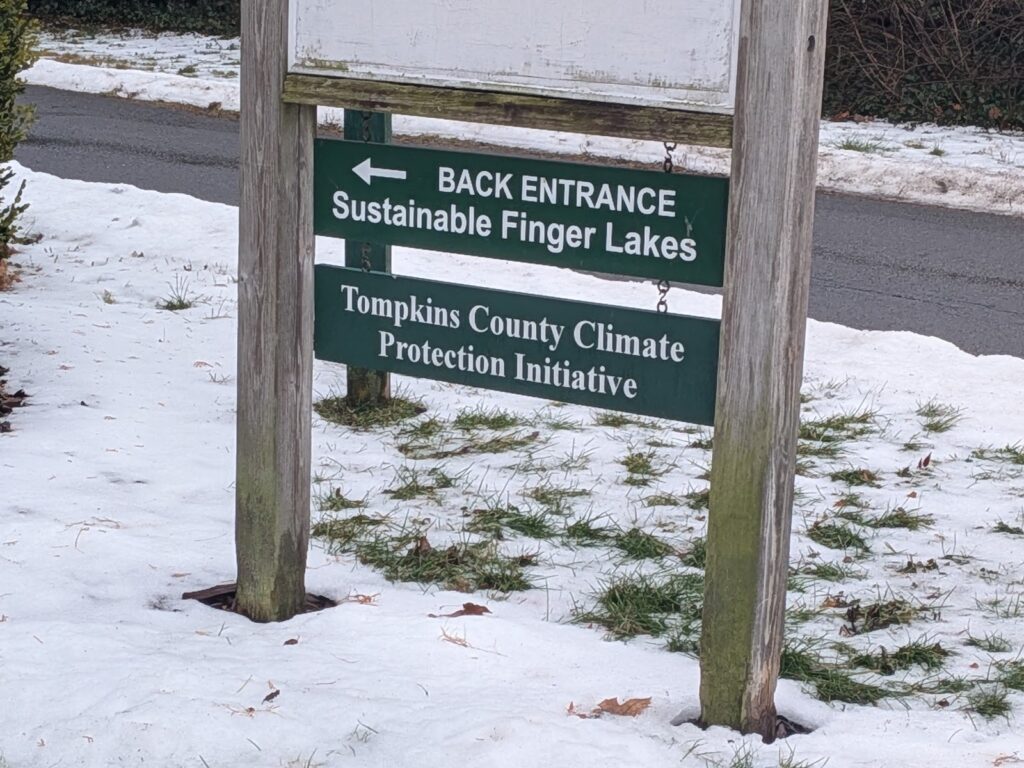
Along with state-level policy deprioritizing sustainability, local climate policy has suffered. Since the 2019 adoption of the Ithaca Green New Deal (IGND), Ithaca has pledged to reduce emissions and improve equity; however, the deal has had varying periods of support and funding since then. The IGND has not received money from the City in years amid budget constraints. The Justice50 program, which aims to set aside money and jobs involving sustainability for disadvantaged groups of Ithacans, did not receive funding following city budget uncertainties earlier this year. Peter Bardaglio, founder and coordinator of the Tompkins County Climate Protection Initiative (TCCPI), and executive director of its flagship program, the Ithaca 2030 District—which aims to reduce greenhouse gas emissions and implement sustainable practices in downtown Ithaca—says of budgets for projects like the IGND, “This stuff trickles down, federal, to the state, to the local, and so I think that puts a lot of pressure on sustainability and climate and energy initiatives in the city […] between the pullback on the part of the governor and the rollbacks on the part of the federal government, there’s real, serious funding constraints.”
Facing a rocky road ahead, supporters of green policy will have to be creative. With the Trump administration acting against sustainability efforts and a strapped state government, staying local will likely yield the best results. Programs that incentivize the creation and use of solar energy may work well. For example, the Cornell Cooperative Extension’s Energy Warriors program educates low-income Ithacans and prepares them for sustainable employment. Additionally, “one significant sign of hope is the plunging price of electricity that’s generated by solar,” Bardaglio says. “It makes it just as pragmatic to go about building utility scale solar projects as it does […] building nuclear power plants.”
If progress is to be made, it needs to be through unique and thoughtful techniques: “new technology is going to help us address some of these problems, [but] we have to try to change the culture too,” Bardaglio says.