
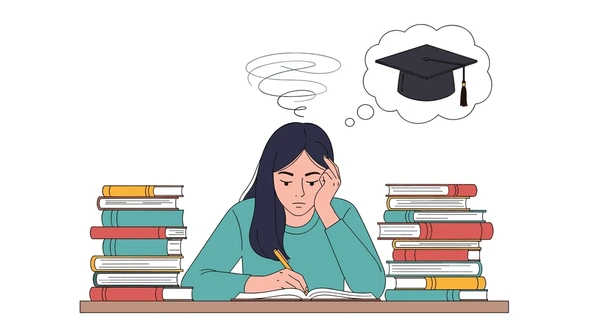
When school ends, most students aren’t actually “done” with school—they’re just switching to a second shift of work that includes homework, sport practices, rehearsal, family responsibilities, and so much more. The constant comparison among students of their extracurriculars doesn’t help. Burnout is often viewed as a “personal failure”—a failure to manage time and be disciplined. However, major health organizations are framing it differently, saying burnout is a response to chronic, unmanaged stress. The World Health Organization describes burnout as being linked to prolonged stress, and characterized by exhaustion, depersonalization, cynicism, and reduced effectiveness. When schools function like a full-time job with overtime activities for students, it can bleed into all aspects of a student’s life, taking over their time.
National data shows that a significant number of high school students are struggling with mental health symptoms that can be linked with burnout. In the Centers for Disease Control and Prevention’s (CDC) Youth Risk Behavior Survey in 2023, 39.7 percent of high school students reported persistent feelings of sadness or hopelessness, and 28.5 percent reported poor mental health. The same report found 20.4 percent of students seriously considered attempting suicide. Those numbers don’t prove that students are “burnt-out,” but show how many students are living with persistent strain, all while still being expected to perform at a high level.
So, why does burnout feel so common in recent years? One reason is that the definition of “a good student” has been romanticized. It’s no longer just grades; it’s the whole transcript. For students aiming for top selective colleges, there is often pressure to take the hardest classes available, earn leadership titles, maintain a sport or instrument, volunteer consistently, and still have a “unique” personality. Even when adults say “don’t overload yourself,” students feel pressure from their peers, causing them to believe that if everyone else is doing it, and if you don’t, you’ll fall behind.
Peer pressure isn’t always direct. Often, the casual hallway talk about who’s in what class, the group chat panic the night before an exam, the list of college acceptances that circulate each spring, and the subtle status attached to being “busy” can create pressure for students. In a competitive environment like high school, overworking yourself can start to look like ambition.
College admission anxiety intensifies overworking, because the timeline feels unforgiving. A single bad quarter can feel like it “ruins everything,” even if that isn’t true. Students may add one more AP class for a better “chance,” or keep piling on commitments because dropping something feels like quitting. Over time, students can feel that the point stops being learning, and instead the goal becomes just getting through the week.
The tricky part is that burnout isn’t solved by a single “self-care” tip. Still, there are real solutions, and they don’t require pretending that stress will disappear. At the individual level, one of the most effective ways to prevent burnout is consistent sleep. If a student is chronically short on sleep, it triggers anxiety, low motivation, mistakes, and a sense of failure. Building even one sleep rule for yourself, like a consistent wake/sleep time or a phone-charging spot away from your bed, can create more stability than other “productivity hacks” spread online. Students can help each other by changing what gets normalized. When someone says they slept two hours, the automatic response shouldn’t be “impressive.” Instead, students should push to normalize getting sufficient sleep and making time for self-care activities.
However, the most important shift is cultural: we need to move from the idea that the “best” students are the most overloaded to the idea that the “best” students are the ones learning deeply. Ambition shouldn’t require burnout as proof.
If burnout is becoming normal, that’s not a sign students are weaker. It’s a sign the system of expectations is unsustainable.