
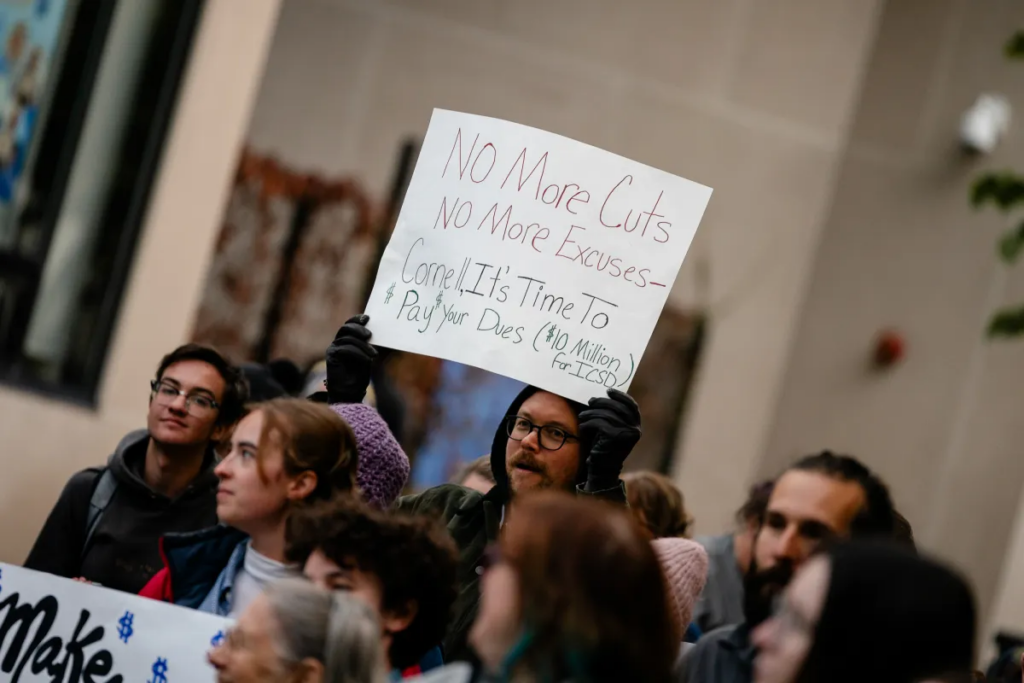
Over the past many years, the subject of Cornell University’s contributions to its Ithaca neighbors has grown contentious. The school, being a nonprofit, does not have to pay property taxes to the City of Ithaca for much of its land; this is a massive boon for one of the largest campuses in the US. However, while property and school taxes in Ithaca proper rise, it leaves many Ithacans wondering why Cornell doesn’t take on greater financial responsibility for its neighbors, especially the students of Ithaca. Cornell has finally responded to Ithaca’s requests: over the next five years, it will spend nearly a million dollars more on ICSD funding than it was previously projected to.
Cornell plans to pay the school district in compounding increments. Next year, it will add an additional 50 thousand dollars to its existing 650 thousand dollar annual contribution; the year after that, another 50 thousand dollars on top of the first, and then an additional three percent on top of each previous year until 2031. This is tremendous news, especially considering that Cornell’s choice was made voluntarily, and during a time of financial crisis for the university—it continues to face massive budget cuts from the US government. However, some would argue that the additional 900 thousand dollars from Cornell over the next five years doesn’t come close to covering what Cornell would be paying in property taxes, were it not exempt. Despite the additional money in the ICSD’s budget, property holders in Ithaca are still paying roughly seventy-five percent of the district’s budget.
ICSD of course welcomes Cornell’s contributions eagerly, considering that they, too, are experiencing financial burdens. With a budget scare a couple of years ago and recent negotiations with teachers resulting in increased salaries, the district has a lot to consider when it comes to allocating funds. However, the additional 50 thousand dollars barely makes a dent in the district’s annual budget of over 150 million dollars. In fact, it doesn’t even cover the hire of one additional teacher within ICSD. Dr. Luvelle Brown, superintendent of the district, made both sides of this clear: he is appreciative that Cornell is making the effort to increase their contributions to Ithaca’s student body in a stressful time for all parties, and he hopes they’ll be open to future increases in payment as well.
Cornell has also committed itself to non-monetary contributions to Ithaca education. The university plans to increase programming within ICSD, access to Cornell labs, and connection with Ithaca teachers, especially in the STEM departments. Other Cornell programs, like Cornell Cooperative Extension, support education initiatives throughout Ithaca and New York state.
The fact of the matter is that the additional million dollars Cornell plans to pay the ICSD over the next five years is not what it could be, but isn’t nothing either; it demonstrates to the residents of Ithaca that their neighbor up East Hill is hoping to improve its relationship with the surrounding community. Perhaps, if America’s economic turbulence clears itself up, Cornell can revisit what contributions it’s making once more.