
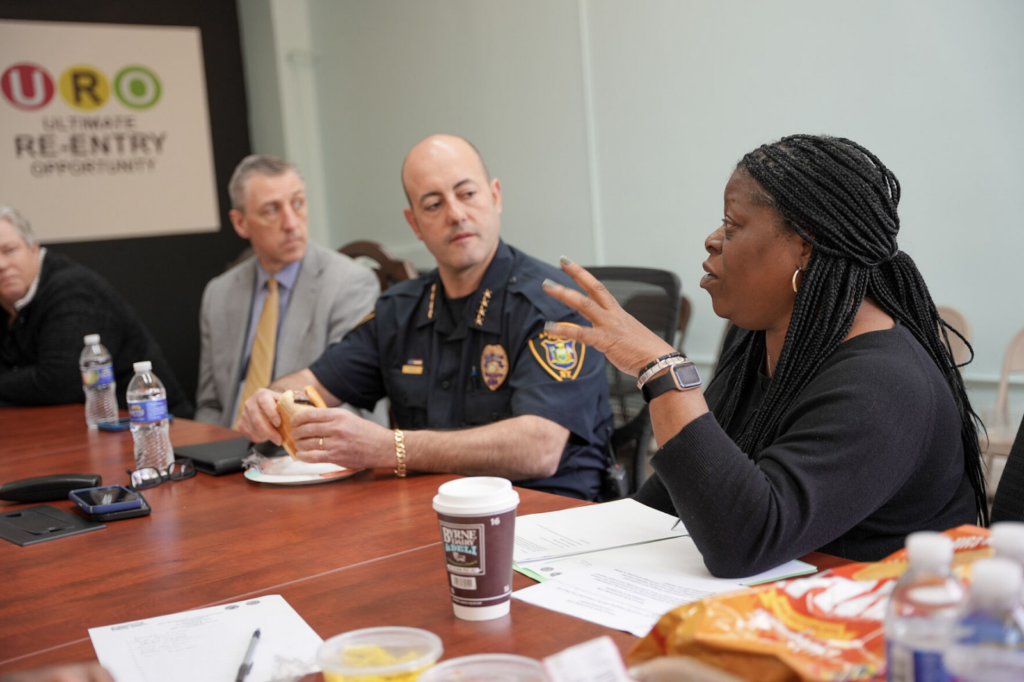
On February 4, the City of Ithaca launched Responders Offering Outreach, Trust, and Support (ROOTS), a pilot program built to respond to some 911 calls with trained community members rather than armed police officers. The program will run through 2028, after which the City will decide whether or not to continue it.
Ithaca hopes ROOTS will help improve community safety, strengthen community relationships with the Police Department, and gain the trust of all Ithacans. Acting City Manager Dominick Recckio explains, “By piloting the program with a small team, by relying on existing funding, and by working closely with our police and community partners, we are creating a strong foundation for a model that prioritizes trust, outreach, and real support for our community.” Project Director for the Community Justice Center (CJC) Monalita Smiley divulges, “It’s gonna be a process. We’ll hit some challenges, and we’ll have some successes.” Police Chief Kelly and Project Director Smiley both agree that the goal of the program is not to replace law enforcement, but instead work with them. Smiley considers ROOTS “a practical and community centered step toward a safer and more supportive Ithaca.”
The plans of this pilot program are to uplift the morale of the city of Ithaca Police Department (IPD), cut back police brutality, and gain greater trust from Ithacans. Mayor Robert Cantelmo supports this program and encourages it as he states, “The establishment of ROOTS strengthens our public-safety system by adding a trusted, alternative response focused on care, de-escalation, and connection making Ithaca safer, more just, and more supportive for everyone.”
About 750 thousand dollars were set aside for ROOTS from previous years, according to Smiley. This money was split into two parts; 200 thousand dollars needed to cover staffing and equipment and 350 thousand dollars for the first year of operations in 2027. The remaining 200 thousand dollars will be needed for 2028.
Smiley says it’s important to think about the social impact of the program, in addition to the financial impact: “In my opinion, there is no monetary amount that you can assign to the social cost. It is more how much our community has invested in this idea and the transparency the creators are providing.” If the program fails to provide clarity to residents, it could lead to failure, reduced trust, and possibly division in the community.
Racial justice in the criminal justice system is an important part of this conversation. “There have been many police brutality cases [in Ithaca], and on one of those occasions a male officer shot and killed an African-American young man downtown.” The man Smiley references is Shawn Greenwood, a beloved community member and father of two, who was murdere in 2010. As a result of this the City of Ithaca developed this program to reduce police brutality. According to Smiley, “Our BIPOC [Black, Indigenous, and people of color] and other race community members have been waiting since the murder of George Floyd for a program of this nature to be established. There were countless focus and working groups to assist in the development of a program of this caliber.” Since this program has only been in place for a short time, it is still undetermined whether this program will succeed in reducing police brutality.
Smiley says that there was a lot of community support for this program, and she believes without this support they wouldn’t have been able to launch this program entirely: “This unarmed responders program has been under construction for several years. We had the support of our community members to see the transparency of the work and the commitment from our city to make this happen. Like mentioned before, there were members of our community that made a huge commitment to seeing this work happen.” Without this strong community support, the initiative would have likely failed or not have gotten the attention it needed.
Lastly, this program was based on many other programs with similar intentions. According to Smiley, “The CJC and the City of Ithaca have researched several programs similar to our upcoming ROOTS program. The STAR (Support Team Assisted Response) program in Denver, Colorado and the HEART (Holistic Empathetic Assistance Response Team) program in Durham, North Carolina are models that we are able to pull information from and create a tailored program for the City of Ithaca.” She also says they are meeting weekly with these programs to get the support and help that they need.
By looking to other cities for help and working closely with local Ithacans, ROOTS hopes to make Ithaca safer, less violent, and more trustworthy. City leaders believe that this program can regain the trust of Ithaca residents with past trauma from officers, and make Ithaca a better place. As this pilot program begins, city officials and community members will monitor this closely to see whether it will succeed in its goals.
Ithaca’s approach feels like an important step toward rethinking public safety in a way that centers community relationships. Hopefully, other cities will look to this model if it proves successful.