
The last weeks of the school year can evoke a whole host of emotions, but soon dread in anticipation of Regents exams may not be one of them. New York State is planning to remove the graduation requirement for Regents exams, amid a transition to a more flexible and holistic system called Portrait of a Graduate. In the plan, which will gradually update diploma requirements over the next several years, the State says Regents “will be one of the many options students could use as evidence of their proficiency.” Portrait of a Graduate, part of a plan called NY Inspires, uses evidence-based pedagogical methods like performance-based assessments and project-based learning. It is not yet clear how students will be able to show proficiency other than through standardized tests.
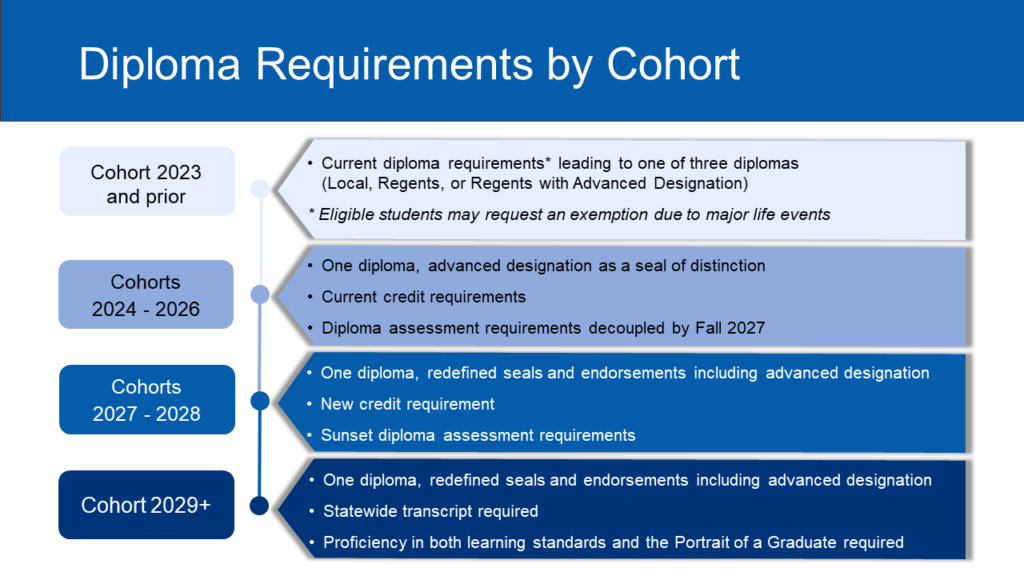
Students will likely not yet notice major changes. While adjustments to graduation requirements will likely start to take place while some current students are still in high school, all students will continue to take Regents exams as normal. According to the NY Inspires plan, passing Regents scores would not be required starting with Class of 2028 graduates, and the new graduation system would fully come into effect starting with ninth-graders in the 2029-2030 school year. Currently, to graduate, students must at least pass a Regents exam in English, mathematics, science, and social studies and complete additional requirements, called a “pathway,” in one subject area—all on top of earning twenty-two credits. Starting in the 2027-2028 school year, the three diploma types—Local, Regents, and Regents with Advanced Designation—would be consolidated into one New York State diploma.
To some, these are welcome changes. Some consider statewide examination systems archaic and without overall benefit. Griffin Brahler ’29 noted that “most of the country doesn’t do Regents. We’re one of just eight states who [require standardized tests]. It just doesn’t make sense.” Discussing drawbacks of such systems, state nonprofit Advocates for Children of New York points to studies which “have found that exit exams can increase high school dropout rates, especially for students of color and students from low-income backgrounds,” and cite a lack of clear, overarching benefits to such standardized testing.
Additionally, requirements are rigid, and formalities mean students in special circumstances sometimes have to overextend themselves so transcripts reflect their abilities. For example, Cornelia Ye ’27, after taking Algebra I in a different state, will need to take the Algebra I Regents exam years later, as not doing this would mean she would not receive an Advanced Designation on her diploma—even though her scores on other Regents exams validate her abilities in mathematics, she says. “Despite the fact that I had exceeded the score needed to receive a Regents Diploma with Advanced Designation on both my Geometry and Algebra II exams, I will be required to take the Algebra I Regents Exam in June to receive the honors endorsement,” Ye stated. “To some extent, this requirement exhibits that these exams are not intended to demonstrate that I have mastered a topic as much as they are simply a requirement that needs to be completed unconditionally.”
However, it could be argued that standardized tests are part of what has made states like New York desirable for education. Removing standardized tests could result in bigger differences in education quality and standards across individual school districts. Victoria McDougald of the Thomas B. Fordham Institute, a conservative education think tank, argues that standardized tests provide important data about how students are doing in school that can be used by parents and educators, helping to spotlight gaps that could otherwise go unnoticed. Additionally, McDougald notes the importance of these tests’ objective qualities, where each student’s work is examined based on the same criteria—something that cannot be found to this extent in local grading.
Though not required, Regents exams will remain central in the consolidated New York State diploma. Students who complete many Regents exams will be recognized through a series of updated endorsements that can be added onto the new diploma, including advanced designation seal. Some of these seals, however, will also recognize students who choose to demonstrate mastery in different ways.
While the change will be a big shift, some of its practices have already been in place in ICSD for decades. Lehman Alternative Community School (LACS) is part of a group of New York schools called the New York Performance Standards Consortium that use approaches similar to the proposed New York State system. LACS, which administers Performance Based Assessment Tasks (PBATs) instead of most Regents exams thanks to a waiver from New York State, has said that their methods better prepare students to be citizens in the real world.
“[Performance-based] assessments provide an authentic opportunity for students to demonstrate their knowledge,” said LACS school counselor Alan Miller in reference to PBATs at LACS, noting such “assessments are a critical part of the new Portrait of a Graduate.” Miller also highlights a part of Portrait of a Graduate expecting students to be “Creative Innovators and Global Citizens,” comparing it to LACS’s Essential 1A requirements ordering “participation in ‘family group,’ committees, all school meetings, spring trips, sixty hours of community service, career explorations and senior year projects focusing on sustainability and bias” at LACS. A Scientific American article found that project-based learning and PBATs brought out transcendent thinking in students. Teens in their normal lives showed more “curiosity and thoughtfulness […] rather than engaging in superficial and reactive thinking,” such that traditional curricula trains students to. Through project-based learning, research shows content is absorbed better. Research led by Lucas Education Research showed significantly higher scores of students who took classes through project-based teaching styles. AP US Government and AP Environmental Science students scored on average eight percentage points higher—and improved scores were present throughout socioeconomic statuses.
New York is not the first state to make these changes. In 2024, Massachusetts voted to phase out its graduation requirement for students to pass the Massachusetts Comprehensive Assessment System high school exams. New York and Massachusetts’ departures from requiring standardized “exit exams” mean just six states—Florida, Ohio, Louisiana, New Jersey, Texas, and Virginia—remain with such a requirement.