
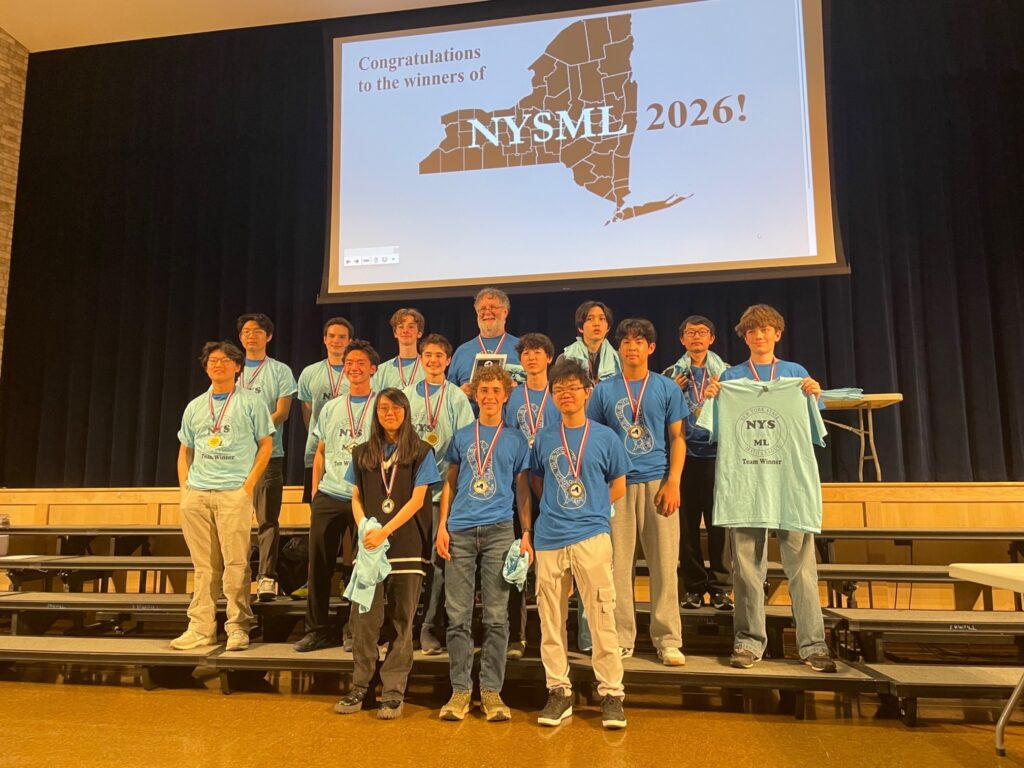
For the first time since 2011, Math Team secured a first place finish in Division B at the New York State Mathematics League Competition (NYSML). The club sent fifteen students to the competition on April 18, which hosted teams from across New York State at Webster Thomas High School, near Rochester.
Along with their first place finish, the team also won the Harry Ruderman Award for the Most Improved Team, which is awarded to the team with the highest score improvement. This was especially meaningful because, as many team members noted, this was the hardest NYSML they had ever competed in. Connie Zheng ’26 emphasized that “this NYSML was harder than previous years, and the score distribution definitely reflects it.” Still, as Math Team advisor Frederick Deppe put it, “we don’t shrink from a challenge.”
The competition was composed of four parts: the team round, the power round, the individual round, and the relay round, and featured questions across a range of mathematical fields, including algebra, geometry, combinatorics, probability, and number theory.
The competition began with the team round, during which all fifteen students collaborated to solve ten problems in twenty minutes. Ithaca correctly solved six problems, scoring the highest in Division B. The Math Team officers underscored the importance of their strategy in ensuring success in this round. Treasurer Joseph Barbash ’27 explained that they wanted to make sure “everyone was able to contribute in some way,” so they split into groups to work on different halves of the test. Within those groups, Co-President Liang Cao ’27 described how “we had multiple people working together on the same problems,” so that each solution could be completed and checked collaboratively. Both Barbash and Cao emphasized that “the team round is a collaborative effort,” and Barbash noted that improved planning this year allowed for stronger teamwork.
After the team round came the power round, which was an hour long and contained ten questions connected by a single theme, requiring proofs and open-ended explanations. This year’s theme focused on primitive triangles, triangles with integer side lengths that are coprime, along with Pythagorean triples and Heron’s formula for the area of a triangle. Co-President Mookie Lundgren-Lahav ’27 described how practicing proofs together in club meetings earlier in the year helped prepare the team, giving them strategies and familiarity with key theorems.
The collaborative atmosphere from the team round carried over to the power round. Dabin Lawler ’28 described how “at any given moment, there were multiple people working together and communicating,” often gathering together to discuss problems while solving them.
The next round was the individual round, which consisted of ten questions given in pairs, with ten minutes per pair. Joonho Park ’26 and Cao were Ithaca’s top scorers, solving six and five problems, respectively. Both noted that the round felt significantly harder than expected compared to previous competitions and practice sets. They stressed the importance of attempting every problem, even without a clear approach. Cao described his mindset: “If it was a geometry problem I would start drawing a picture. If it was an Algebra problem I would start writing down an equation that had to do with the problem, and I would see where that takes me. […] Maybe I can manipulate the equation somehow. Maybe I can draw an extra line. Maybe there’s a right triangle or area property I could find.” Cao affirmed that this persistence enabled him to overcome frustration, which ultimately contributed to the team’s success.
The fourth and final round of the competition was the relay round. In this round, teams are divided into groups of three. The first person is given a problem to solve and, once finished, passes their answer to the second person. The second person’s problem depends on that answer, and after solving it, they pass their result to the third person, who uses it to find the final solution. If the third person submits the correct answer within three minutes, the team earns five points; if completed within six minutes, they receive three.
Jihoon Hong ’26, who competed as the second leg on Ithaca’s best-performing relay team, said his goal was to “solve the question as fast as possible” once he received the first answer. To prepare, he simplified the expression in advance so he could quickly plug in the value when it arrived. Hong explained that the strategy of each role is different: “while the first and third legs focus on accuracy, the second leg prioritizes speed.”
Park, as the third leg, took a slightly different approach, trying to anticipate possible values so he could “basically have an answer ready.” By the time he received the final number, “the math was pretty much all done.” Lundgren-Lahav, who also served as a third leg, emphasized the importance of a “thorough understanding of what the problem is really about,” which allowed him to derive a formula and quickly substitute the final value.
Deppe especially commended the team’s performance in the relay round, noting that it was “something that we had struggled with in the past,” but that “we really made progress.”
Many team members attribute this year’s success to a shift in focus. Lawler observed that the team was “more driven this year” and “more competition-oriented.” Cao explained that in previous years, the club emphasized lectures on applied and abstract math, but this year focused more on competition topics like algebra, geometry, combinatorics, and number theory. Lundgren-Lahav also emphasized the importance of making competition math more accessible to everyone, explaining how he hoped the club would help them build a foundation to dive into deeper topics.
Along with this shift, the officers placed a strong emphasis on practice. In the weeks leading up to the competition, they simulated each round so members could become familiar with the format. For Kai Kwee-Hallem ’29, attending his first high school math competition, this was “really helpful for practicing our skills and building our confidence.” Deppe added that the team worked to make sure “everyone was comfortable with each round,” and credited strong participation and collaboration during meetings.
The team also had many positive interactions with students from other schools. Kwee-Hallem described playing games with other teams at lunch, and Alex Guo ’27 shared that he made new friends, calling the experience “a wonderful one.”
Overall, team members expressed a strong sense of pride. Cao described NYSML as the team’s capstone: “this is what we worked hard for all year, and it culminated in a great achievement.” Kwee-Hallem felt that “all of our hard work and preparation had paid off.” Math teacher Riya Burke, who served as a proctor for the competition, said that “all of the students here worked incredibly hard, and they really deserve the honor,” and added that “everyone should give Mr. Deppe a pat on the back when they see him.”
Still, the team was surprised by the result. Zheng recalled that after the announcement of their victory, “we waffled around for a minute or two because none of us could believe that we won.” Hong expressed a similar shock, stating, “I wasn’t expecting to win something. I just [attended] to support the club.”
Math Team meets every Tuesday after school in H211. Lundgren-Lahav described it as “a really great opportunity to get a feel for math outside of the high school curriculum […] and to practice your problem-solving skills.” Deppe added, “Everybody’s welcome. You never know what kind of problems you are going to get, but they are always really interesting and challenging.”