
What’s your opinion on AI? This is a question that we posed to forty-three students and teachers across IHS. You may recall being in class when your teacher called out a student for using AI, or when a teacher used AI to give students critiques on writing. While AI has sparked great controversy over water use, lack of cognitive engagement, and social disconnection, there are other crucial concerns in AI usage. In this article, we will focus on how teachers, and students, feel about AI, but more importantly, how this shapes our perspective on how AI should be used in education.
The overwhelming majority of teachers defined AI as something that has a high capability to be manipulated to gather people’s private data or surveil students. In fact, teachers stated that AI is, yes, a tool, but a tool that is getting out of hand. Similarly, many said that forms of AI are powerful and must be used with extreme caution.
Some teachers did not like generative AI specifically, as it usually just regurgitates information. For example, a student teacher commented that higher education students use AI to analyze what the teacher said. However, the information is often irrelevant to the topic, so they have to be careful. Their main issue was that, to “learn from AI,” you have to be specific.
On top of this, many teachers asked the question: if students use AI to do work, or help with studying, are they still learning? Overall, we should all be genuinely concerned and act as critical thinkers about AI use in education, just as we should with social media.
The students that we interviewed had greater variation in perspectives. The underlying thought was that AI is bad for the environment, that it steals your livelihood, and that it is horrible in general. One student commented that they were more neutral about their opinions on AI. However, four in ten students said they used AI to complete school work or to simply study.
Overall, there are many uncertainties. The danger is AI changing and developing too quickly for us to react, but we can conclude that there are benefits and drawbacks to AI usage.
Think back a few years—do the opinions above sound much different from what students and teachers had thought then? I remember we were just considering how students were increasingly using generative AI, not how corporations could create AI that can analyze genomes and take data without getting in trouble.
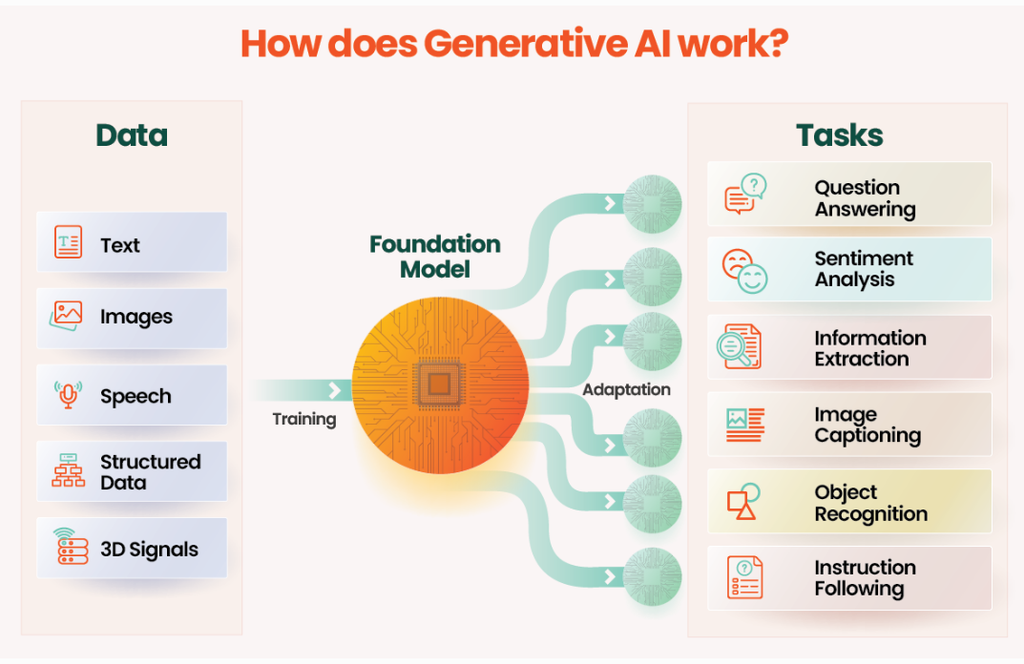
So, what are the main takeaways on our perspectives on AI? First, we all seem to have a blurry definition of AI, since it’s a developing field of research. So then, what is AI? According to the National Aeronautics and Space Association, AI, or artificial intelligence, is defined as “a computer system that can perform complex tasks.” The form of AI that is often discussed and makes headlines relating to schoolwork, is generative AI. Generative AI takes your prompt, gathers information from websites and databases containing keywords from that prompt (regardless of credibility), and spits that information back out for you.
Now, of course, this is very baseline, and it’s all relative. All AI runs on a process called machine learning. Machine learning recognizes patterns in data and makes predictions based on the data. Traditional AI, is a broad term for AI that completes tasks using machine learning that is “predefined” and acts more like a strict algorithm.
Generative AI uses a special type of machine learning which is creative and more fluid. This enables generative AI to complete human-like tasks, like writing an essay.
The type of AI that we are concerned could hurt humanity using bioweaponry is genome language models. These are a type of generative AI that can analyze and build genomes. So, why are our definitions of AI not more specific if we have this abundance of them? The difficulty is in what news channels, and overall media share about AI and what it means.
Recently, you may have seen headlines in the news similar to this one: “Number of Higher Education Students Falls as AI Dominates Fields That Require a Degree.” As high school students, we’re often asked about our future—whether we want to go into trades or higher education. Let’s just say the pressure to attend a good college is immense in many households and academic settings.
But with increased use of AI to replace jobs that require degrees, many people—from hearing stories on social media, or watching the news—have decided that college is useless. The media has portrayed AI as something that will just take over the world and keep advancing—something that is too powerful to be stopped. This has led a generation of students to lose sight of the importance of education, since AI will just “take over the world.”
Opinions from students seem very sheepish and frantic. This is because many students face great anxiety and self-consciousness over using forms of AI to get work done. So then why has generative AI usage increased?
Our thoughts on why students may use AI for school work are that many are scared to ask questions to teachers, or simply do not have the time to complete their work. The challenge is that this leads many to not have the skill set that older generations have, including researching, no AI included, or learning how to balance the stress of work with extracurriculars. When we all start to be dependent on the algorithm for skills and tasks, we all start having the same answers to the same questions, like an algorithm. Principally, we need to be better than the algorithm and truly start to do the things that define what it means to be human: be compassionate, be an individual, and have curiosity.
While our opinions on AI have created biased definitions that affect our usage, our mental health and who we are, there is another thing we have lost that ties all of these themes together: grit. Grit, by definition means “courage and determination despite difficulty.” Grit is what keeps mathematicians vexed, scientists hypothesizing, and welders creating new designs. When generative AI came into our sight, we were curious, as we are with many technologies. We quickly realized that we could get work done faster, easier, and more efficiently if we outsourced it to AI. We started to lose the satisfaction of writing something you can call your own, or solving a problem you’ve been working on for three days.
High school is a critical time for developing our skills. Having skills gives us purpose and a sense of direction for where we’re heading with our future. Skills are what give us grit, because having a skill means you have persevered through the bad, whether in a sport or in STEM. The common thread among all of our opinions is that we want regulation on what researchers can do with AI. Now, it is up to us to be scared or empowered about the current state of AI. It is up to us to show some grit in our opinions, and really work hard for them to be voiced and heard.
Be First to Comment