
Althea Gibson was an American tennis player and golfer Gibson grew up in Silver, South Carolina, later moving with her family to Harlem, New York, in hopes of better opportunities. Gibson’s introduction to sports was basketball, shortly after learning paddle tennis (a modified version of tennis), and then going on to find more sports to play.
By age twelve Gibson was already New York City’s women’s paddle tennis champion. She always said, “As a black child, I had to wait until the tennis courts were closed at night to be able to play. I mastered my signature swing in the dark.”
Gibson later joked that some of her best shots came from having to know the court lines by heart. She found something in sports that she could not find in school: a rush. She would end up dropping out of high school before the age of eighteen.
When Gibson was fourteen, she entered her first tennis tournament, the New York State Championship, and won. New York Journal sportswriter, David Eisenberg, said, “I have sat in on many dramatic moments in sports, but few were more thrilling than Miss Gibson’s performance against Miss Brough. Not because great tennis was played, because it wasn’t. But because of the great try by this lonely, and nervous, colored girl, and because of the manner in which the elements robbed her of her great triumph.”
Gibson was seventeen when she made another move. This time, she traveled to live with Hubert Eaton in North Carolina. Eaton had seen promise in Gibson and wanted her to get a tennis scholarship at a historically black college.
She trained on real-sized courts, right down the road from Eaton’s house. As she grew older and spent a few summers in North Carolina, she practiced her skills and built strength. She also trained with Robert Johnson, a famous coach and author. At seventeen, she went on to win her first Junior National Championship.
Johnson supported her music career, while Eaton encouraged her to work back toward the high school experience he realized she would miss. At age twenty, she went back to school and earned her diploma. She then pushed herself to attend Florida A&M University, where she received a bachelor’s degree. When Gibson was twenty years old, she won the first of ten straight American Tennis Association (ATA) women’s national titles. She also won six New York State Championships between 1944 and 1950. However, within the ATA she was denied many opportunities because of racial segregation.
When she was twenty-nine years old, she held on to the lyrics of persistence and courage. She grabbed the Champion’s Ball bandleader’s microphone and started singing along to the song “I Can’t Give You Anything But Love.” She ended up having a successful musical tour and a record contract. By age thirty-two, she had released the song “So Much to Live For,” written by her vocal coach. She also branched out to other areas, recording a jazz album and getting a role in a movie called The Horse Soldiers.
Gibson once sang, “I always wanted to be somebody. If I made it, it’s half because I was game enough to take a lot of punishment along the way and half because there were a lot of people who cared enough to help me.” Through all of her struggles, including being banned from dining rooms, tennis courts, and locker rooms due to segregation, she kept persevering and shocking the world with her outstanding accomplishments in tennis, breaking barriers for women of color.
At twenty-nine, Gibson won the French Championships. When she was thirty, she won Wimbledon, in both singles and doubles. During one of her Wimbledon wins, Queen Elizabeth II came to watch a match for the first time. “Shaking hands with the Queen of England,” Gibson later said, “was a long way from being forced to sit in the colored section of the bus.” She also won the US Nationals that year. At thirty-one, Gibson repeated these two wins. By the time she was thirty-five, she had become the first African-American to play in the US Open.
For fifteen years, Gibson held the record for being the only woman of color to win a major championship. Forty-three years later, in 1999, Serena Williams broke that streak when she won the US Open, becoming another African American woman to win a major singles title. Gibson was ranked number one in the world as of 1957, and she was a two-time Wimbledon tennis champion, along with a two-time winner of the US Open tennis championship. Over the course of her great tennis career, Gibson won eleven Grand Slam titles in total. She earned six double crowns because of her own success. Later, Gibson retired from tennis and turned professional again, this time in golf.
Gibson was unable to earn much money playing professional women’s tennis, so she turned to professional golf. She was an honorary member of the Englewood Golf Club, becoming the first Black member. This encouraged her to try the Ladies Professional Golf Association (LPGA) Tour at age thirty-six. She became only the second African American player and the first Black female. She had done many incredible things, but only two years after her time in the LPGA, the PGA of America decided to stick to “Caucasian Only.”
At age thirty-seven, Gibson was the first African American woman to join and compete on the LPGA Tour, in 1960. Thankfully, soon after, the LPGA sent a clear message that “either everybody played, or nobody played.” To support Gibson, Alice Marble wrote in American Lawn Tennis, “If Althea Gibson represents a challenge to the present crop of players, then it’s only fair that they meet this challenge on the courts” (International Tennis Hall of Fame). From then on, the players within the LPGA not only welcomed Gibson but also supported her. She was seen as a positive person who had the desire to compete. Gibson made 171 LPGA Tour starts between 1963 and 1977. She tried to advance in golf again, hoping to return to the LPGA Tour Q School, but unfortunately, she failed to keep going. When Gibson was thirty-nine, she was honored during the centennial celebration of The Matches at Wimbledon. Over the course of her whole career, Gibson was the first African American seen on the cover of Time magazine and Sports Illustrated. Palfrey said in a 1956 Sports Illustrated story, “It became apparent early that Althea’s height (five-foot-eleven) and big serve could be a great asset to women’s tennis if she could develop a good follow-up volley.”
She had an incredible twenty-year career, winning eleven Grand Slam titles (five singles, five doubles, and one mixed doubles) and one hundred professional titles. She was a two-time winner of the National Black Women’s Tennis Championship and had good opportunities to head to the US Nationals. At the US Nationals, she was the first Black woman to win, as she was at the French Championships and Wimbledon. Gibson set many records and showed many astounding performances, but every time she tried to break the all-white world of entry into the United States Lawn Tennis Association, she was denied. Gibson said, “I want the public to remember me as they knew me: athletic, smart, and healthy … Remember me strong and tough and quick, fleet of foot and tenacious.”
By the end of her seasons, she was an eleven-time Major Champion, nineteen Major Finals, and an eight-time finalist. In addition, she had a 53-9 record in tennis at the majors, singles and doubles. She went 16-1 at Wimbledon, 27-7 at the US Nationals, 6-0 at the French Championships (when she finally made worldwide headlines), and 4-1 at the X Australia. She was a member of the 1957 (winning team) and 1958 Wightman Cup teams. She was inducted into the International Tennis Hall of Fame in 1971, the Black Athletes Hall of Fame in 1974, and the Women’s Sports Hall of Fame in 1980. Gibson always said, “Remember that breaking barriers is never done alone; it takes both courage and community.”
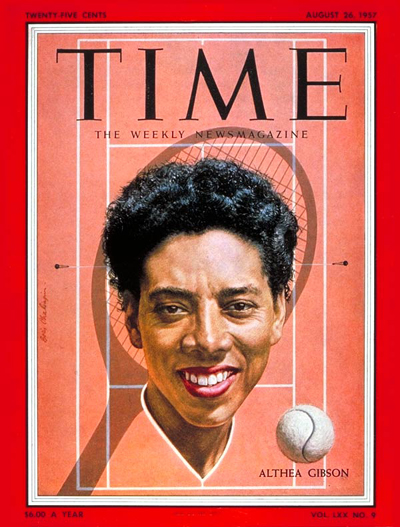
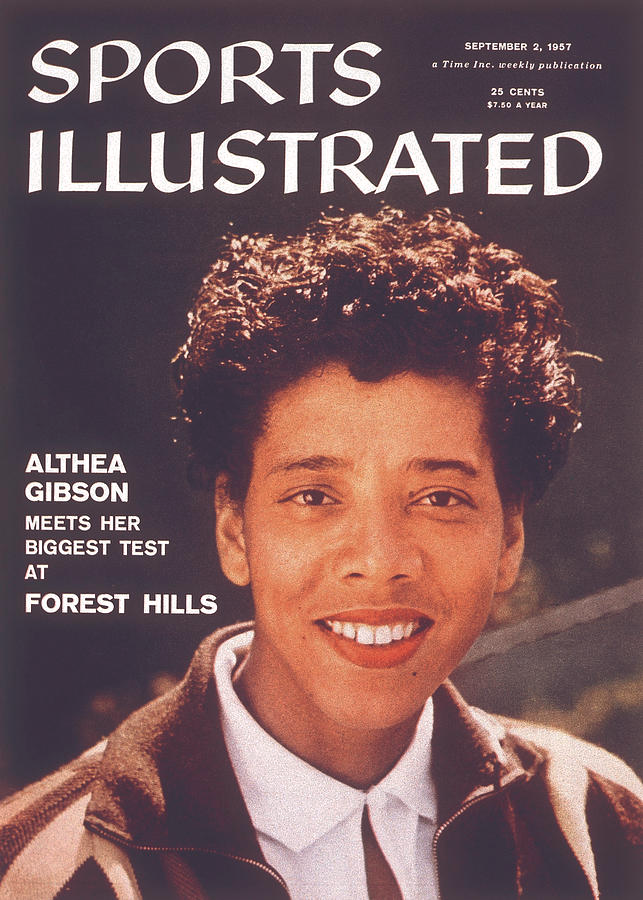
Gibson on the cover of Sports Illustrated and Time Magazine. 1957
Be First to Comment