
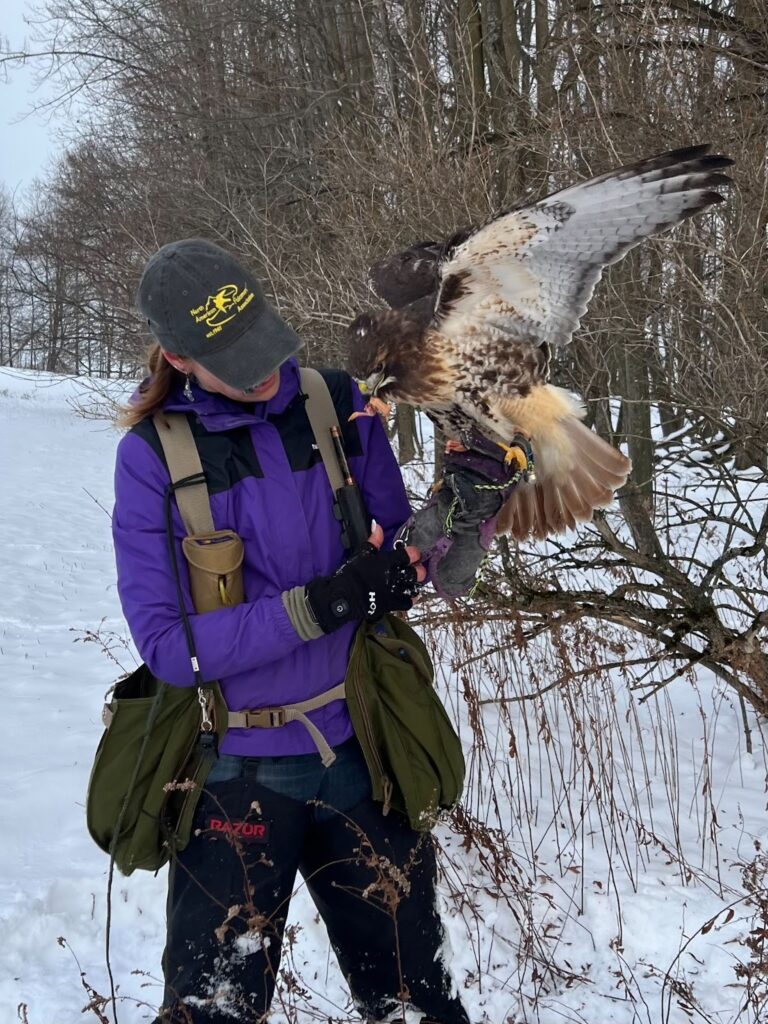
As early as 700 BCE, humans have been catching and training birds of prey for the purpose of hunting. The earliest records were discovered in a bas-relief at Babylon, but evidence of falconry has been found across the globe.
In New York State, the path to legalizing this age-old sport saw much trial and tribulation, with the sport only being legalized in 1978 following months of negotiations between falconers and state legislature. But today, with close to 4 thousand falconers nationwide and over 100 thousand falconers worldwide, it’s safe to say the sport is alive and well in the modern era.
However, falconry requires countless hours of time and significant finances to construct a mew (the small shed used to house the bird), and purchase gear such as hoods, gloves, anklets and jesses (small leather bands that wrap around the bird’s ankles securing them to a glove). The largest cost, however, is that of food for the birds. Wild birds cannot be fed your run-of-the-mill grocery store meat. Instead, falconers will need to purchase day-old-chicks, quail or other whole animals to feed their bird, none of which are cheap.
Beyond supplies, equipment and cost, a falconer’s most precious resources are patience and commitment. Most raptors are not social animals, meaning they do not understand social cues nor respond to punishment. Instead, they must be constantly rewarded with food for each task performed correctly. Yet the impending risk of overfeeding means the amount of food provided to the bird must be carefully monitored. If the bird is overfed and therefore not hungry, a falconer may not achieve the desired results, and may even result in the loss of their bird. The tedious yet rewarding process of training can take weeks, and falconers only have a small window to complete it.
In New York, falconry trapping season runs from September 1 to January 31. This period includes the time it takes to trap a bird (assuming a falconer does not already possess one). Thus, falconers are on the clock to get their birds trained for hunting while there is still game to catch in the warmer months of autumn.
Yet, these challenges will never deter a true falconer. In this sport, the lowest lows are met with the highest highs. Having a bird come to your glove, and being able to assist them in their most natural state (when they are hunting) is a life-changing experience. Building a relationship with a bird, allows falconers to hunt as two halves of a whole, which is the true goal of falconry. Over the course of this sport’s history dating back over two thousand years this goal has stayed constant: building the relationship between bird and human on the hunt for game.
Be First to Comment