
Author’s Note: This article contains spoilers for FEAST. by Megan Gogerty.
Content warning: violence, death.
On Wednesday, May 6, I was thrilled to go see the opening preview of the Kitchen Theatre Company’s (henceforth: the Kitchen) production of FEAST. It’d been a long time since I’d gone to the Kitchen to see a one-woman show (see my review of the Kitchen’s production of Scheiss Book in December 2023), and it felt only fitting that I returned to the Kitchen for a part two of the saga.
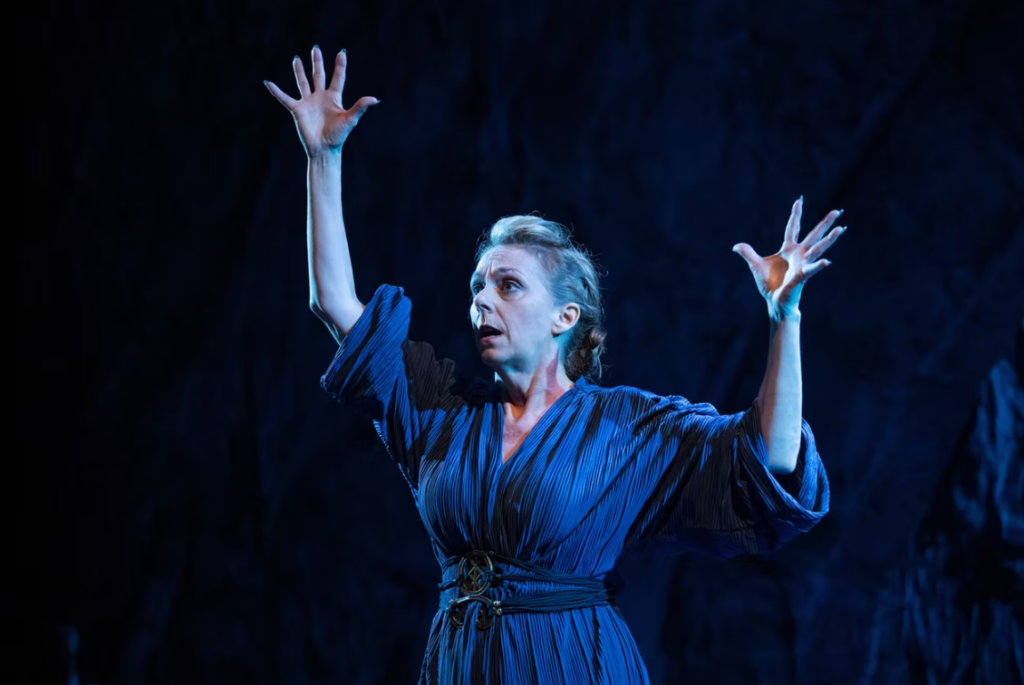
Written by award-winning playwright and comedian Megan Gogerty, FEAST. is a retelling of the classic tale Beowulf, a quintessential epic about a legendary Scandinavian warrior. The hour-long interactive play follows a lone, middle-aged woman (played by actress Brenny Campbell) hosting a lavish dinner party, with eight audience members sitting on stage to give the illusion of a full table.
When I got to the theater, I was pleasantly surprised to find an ornate setup for the eight on-stage seats: each chair had beautiful red and gold detailing, and plates with the remnants of a feast were set up at our placestations. Other audience members sat in traditional theater seats, but due to the Kitchen’s intimate setup, even the furthest audience members were mere feet from the stage. After the “dinner party” commenced with a few words from Emily Jackson, the Producing Artistic Director of the Kitchen, the lights dimmed, and the main (well, the only) character took the stage to introduce herself.
For a moment, the modern dialogue and stereotypical ditziness of our host seemed to steer the play. However, Campbell’s character—who refuses to tell the audience her name until the end of the play—was soon revealed to be the mother of Grendel, the giant-like central antagonist of Beowulf. Throughout the seventy-five-minute play, Grendel’s mother transformed from a sociable host to a deeply grieved creature who sought justice for her son’s killing, and the Beowulf’s killing of Grendel unfolded into an allegory about the contemporary strifes of class wars, authoritarianism, and the patriarchy.
In the process, we audience members became part of the story, especially the eight of us who sat at the tables onstage. Grendel’s mother’s growing rapport with the audience over the show forced us to confront our own sense of loss in the world, just as she confronts the loss of her son. In one striking moment, as Grendel’s mother prepared to die, she passed out singular dates to audience members, each one representing a part of her heart—and then asked us to eat them. During another monologue, Grendel’s mother attempts to console herself from her grief by holding an on-stage audience member in an embrace (at this preview, this audience member happened to be me!). This certainly wasn’t a traditional theater experience, but Campbell’s larger-than-life emotive acting and inclinations to engage the audience made these interactions feel important—no, necessary—to the story.
At the end of the play, Grendel’s mother prepares to die (or, as she euphemizes, to “turn into particles”). However, she realizes that this isn’t the end for her, and that she still has the power to seek justice for her son’s death. Campbell truly played into the audience’s emotions in this moment, mirroring their grief and loss, but then portraying a fresh sense of hope. She finally reveals to the audience her name, Agathae, and then leaves the stage in a flurry, leaving spectators to unpack the complexity of her story on their own.
In a post-show talkback, audiences described the show as “cathartic,” a release of the tension created by our current political situation. Some felt frustrated that Agathae’s resolution wasn’t neatly tied in a bow at the end, but others felt that the conclusion of the story held true to the uncertainty that they feel now. Despite this, all audience members agreed that the portrayal of Agathae allowed them to view their emotions from a new lens. One audience member even described the experience as an invitation to feel more rage and a reminder that a bit of rage is good for all of us.
Overall, I was deeply impressed with Brenny Campbell and the entire production of FEAST. From the stunning light programming, to the intricate set and props, to the interactions with the audience, every aspect of the piece felt intentional. Perhaps the experience would have been more enriching had I familiarized myself with Beowulf beyond the Wikipedia article, but as audience members suggested in the talkback, FEAST. was accessible even for people who didn’t know what Beowulf was.
Although the run of FEAST. is now over, I encourage those who love creative theatre and community conversations to join the Kitchen for their 2026-2027 Mainstage Season next fall. If you just can’t wait until the fall, don’t fret! Local theatre collective Walking on Water Productions is producing their new musical Daughters (Hijas) at the Kitchen from June 4 to June 14. Tickets are available online at www.kitchentheatre.org/kitchensink!
September 2026 | Vol. 134 #1 | Published Monthly | Writers' Deadline: October 17th