
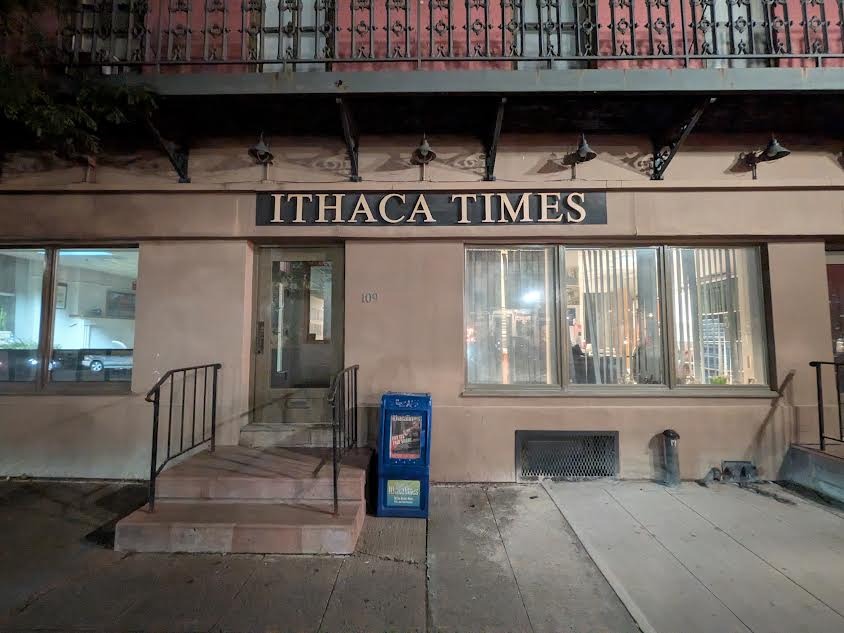
The Ithaca Times announced Wednesday that it received a notice of eviction from its newsroom’s landlord.
“If such legal proceedings are successful, the Ithaca Times and its sister papers may be forced to close temporarily or possibly permanently,” wrote Roy Allen, Director of Strategic Relations, in an announcement on the publication’s website, ithaca.com.
The announcement comes roughly a year after the alt-weekly newspaper announced a shift in organization—from being a for-profit organization to a subsidiary of a newly formed not-for-profit organization called Pathways to Equity. It is a transition akin to ones made by other local newsrooms around the US, whose traditional for-profit models proved a challenge to successfully continue in a digital landscape.
Online outlet The Ithaca Voice went non-profit in 2019, making Ithaca’s only remaining for-profit paper The Ithaca Journal, owned by Gannett, which does not have any remaining local reporters. The Journal does cover select Ithaca stories out of nearby regional offices.
The Times’s fate depends on whether they’re able to relocate—while balancing a delicate budget that reflects the challenging reality for many local newsrooms.
When Jim Bilinski, longtime owner of the publication, sold the Times last year, he maintained oversight of its downtown property. Bilinski started at the publication as an Ithaca College student during the paper’s first months and was a publisher for fifty-three years. As the current building ownership—a family trust Bilinski manages—now sells the building, the Times will not be able to afford to stay in the newsroom it’s been in for decades.
“The landlord [Bilinski]—and, I understand it’s a choice—he has retired and he wants to sell the building,” Allen said in an interview. “It’s not something we can afford to buy, and the requested rent is more than what we can afford,” he said. “We’re in a situation [that] we didn’t expect. We were surprised when we got the paperwork. And again, it’s not his fault; it’s a condition of the market.”
While the Times’s eviction came suddenly, its faltering financial situation did not: the paper’s revenue stream had been steadily decreasing since 2018, Allen said.
As the journalism industry changed through the years, the Ithaca Times’s management failed to adapt quickly, he said. Traditional newspapers like the Times rely on advertisement revenue to stay profitable, and when digital advertising became commonplace, legacy media outlets lost a large stream of funding.
“Years ago the newspapers made a lot of money on classifieds, and then Craigslist came around, and people could post a classified for free, so the media business lost a lot of money,” Allen said.
“The Ithaca Times did not react as quickly as it needed to,” Allen said. “Coming in new, we really had to rebuild and restructure it—and it takes time to do that.”
Forced out of their newsroom, Allen said that the organization will have to move quickly and carefully. He asked for the Ithaca community’s help in maintaining the newspaper as a community resource.
“The community has been very kind to a lot of different organizations. They raised money for the Museum of the Earth, they raised money for Finger Lakes ReUse, and this is an important community. We’ve told stories about both of these organizations and it would be helpful if we could get some support to preserve the paper,” he said in the interview.
Besides financial support, Allen said in the announcement that the Times would benefit from help with finding a new space for the publication to operate out of.
The Times’s newsroom contains, along with day-to-day essentials, decades of archives dating back to the publication’s inception. Allen said that during this transition the group will need to ensure safekeeping of the records, which serve as a backup of local history in case the internet were to fail. “We have fifty-five years of history in the building. We have files, and an archive of information, and there’s community records there. It’s the history of a community for the last half a century,” Allen said.
As much as it is a resource for its readership, the Times has been a support for young journalists. Allen noted the handful of interns the Times has hosted from both Ithaca College and Cornell University—and the experience those students gain from interning at their newsroom.
“We’ve had a lot of interns over the last year and we want to preserve that space. It’s a good training space for people who want to learn to tell stories in the community,” Allen said in the interview. “We’re just looking for some support from the community in a time of need, and it’s not always comfortable asking people for help but people have asked us for help before and we try to do our best to help them, and now we need some help.”
“Maybe today is when our future begins,” Allen wrote hopefully in the announcement. “Maybe miracles do still exist.”
Be First to Comment