
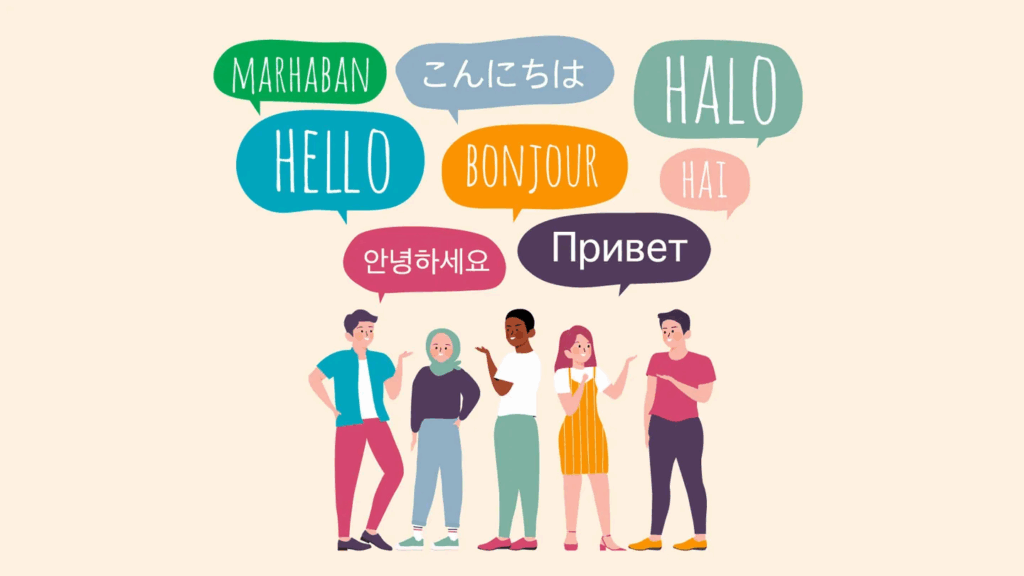
If you’re reading this article, you probably want to learn a language. Maybe it’s because you are going on a trip, or you are planning to live in a different country. Maybe you want to train your brain or just learn something new. While learning languages can be tough, it can be a highly beneficial skill if you take the correct approach. I have been interested in the process of learning new languages; I am currently learning Spanish and Korean, and am planning to study French and Mandarin. My goal is to learn these languages in a manner in which I can learn them easily and get a good sense of reading, writing, speaking, and listening. But how exactly can you do that? Let’s analyze different methods and form the best way to learn a language.
We will start with the resources not to use. The first one is a common mistake: Duolingo, “the world’s best way of learning a language.” Duolingo is free and accessible, and its interface gives the feeling of a mobile game. However, Duolingo does not give in-depth grammar explanations, which will make things hard when you are writing or speaking, and it can be confusing with complex grammar in that language when you come across those concepts in reading, listening, writing, or speaking.
Additionally, its gamified experience can be distracting. One of the features of Duolingo is leagues, where you compete with other users to move up and accumulate points to top the leaderboards. Now, this may sound fun, but in the end, it can be detrimental to your language-learning life. For example, if you are a competitive person who wants to soar to the top of the leagues every week you might find yourself drilling German lessons for an entire week. At the end of the week, you feel rewarded knowing you got first place on the leaderboard. The bad news? You were so focused and distracted on getting first place in your league that you didn’t even remember any German that came from your lessons.
Lastly, Duolingo uses ethos to persuade you that they are leading you the right way. When a lesson is loading, one of the pieces of evidence of why you should use the program is that you can learn about one hundred new words every month if you do fifteen minutes of Duolingo a day. We will come back to that statistic.
Saying that you “learned” a new language only after using Duolingo is a very weak approach. And the truth is, any language-learning app, like Babbel and Memrise, is not going to single-handedly make you fluent in a language. You need to use them as supplements, along with other study resources if you want to reach fluency.These apps may seem convenient, but keep in mind that you will also need other tools.
A second resource that should not be used often to learn a language is artificial intelligence (AI). “Why not?” you may be wondering, “It’s convenient, gives me explanations clearly, and it’s very easy to use it to learn a language!” You need to remember that chatbots can be inaccurate, and the last thing you need is to learn a language the wrong way. Sometimes, AI chatbots can make mistakes and fail to explain concepts from a language well. You should only rely on it if you are desperate and cannot find an answer to an element in your target language.
Now that we’ve gone through those tools, it’s time to make a formula for the best way to do so. This formula consists of being able to master certain aspects of your target language.
The first thing you should do is learn the writing system as soon as you can, if you are learning a language that does not use the Latin alphabet. Do not rely on romanized phrases (or phrases in a language with a different writing system converted to the Latin alphabet) as you go about learning your language, as they could take away from pronunciation and reading skills. To pronounce better, you need to first hear what the letters sound like, and that process constitutes learning that new writing system. Relying on romanized phrases will not take you anywhere. You need to learn the writing system before everything else.
The next step is to learn proper grammar. You will realize why it’s important to know grammar first when you look further into this article. You don’t have to learn everything at once, but when you encounter a grammar concept you are not familiar with, my advice is to try to find out why it’s like that as soon as possible. Use trustworthy sources, and once again, avoid chatbots unless you are desperate to find out about a grammar concept and can’t find the answer elsewhere.
The next thing to do is to speak. Find someone you know who can speak your target language and have a conversation. At first, things may be awkward, but you will see that your conversational skills will go a long way, as it can help you get direct feedback for learning the language and know how to speak in real-life scenarios. If you can’t find somebody who can speak your language, get a phrasebook or round up all the things you know in the language. Speak the sentences you craft or speak the phrases in the phrasebook yourself, depending on what method you are taking. This will help you get a hold of pronunciation.
Next, listening. Listening can be tough to figure out. Find somebody who can speak your target language, and have them say something. Take note in your brain what words you can understand and the ones you can’t. If you can’t find somebody who can speak your target language, do not use robotic language audios, as they are unnatural to human speech. Instead, watch YouTube, or even a movie or TV show, in your target language. Make sure that there is somebody speaking clearly. Use those videos to test your listening skills, and take note of the phrases or words you can understand, even if there are just a few of them. Now, you may wonder: what about subtitles? Many expert linguists say that your brain learns better if you put comprehensible input into your brain, which is noting how the speakers speak, their intonation, and the general sound of the language, even if you can only understand a word or two in your videos, shows, movies, or whatever you are watching. In my opinion, though, I feel you can still get that even with subtitles in your primary language, so you should turn them on. You would be able to understand more things during your viewing experience, and depending on how much of the target language you know, you would also be able to take note of the words that you can or can’t understand, and thus you can pick up new words by going to a translator. Once you are more advanced, though, if you want to turn off subtitles to test your listening skills for real, go ahead.
Now let’s discuss reading. Refrain from jumping into huge novels or books covering complex topics. They are probably going to use words that learners at beginner levels are unfamiliar with. Start with children’s books or other books with a few words, and then build up from there. See how many words or phrases you can understand. The same tactic can be applied if you are viewing a show or a video: have a translator open so you can translate things you don’t understand, and once you find out what they mean, try to memorize them or use them often.
Finally, the part I believe is the hardest in learning a language: vocabulary. It can be tough to learn, since there are so many words out there. A common mistake is to find vocabulary lists online, study them, then try to test yourself by covering the column with the words in the different language and seeing how many you remember. I have made this mistake before, later finding out that your brain seems to know how to say certain words on a list only if it remembers what words were on there. For example, if you wanted to learn the word “calm,” and you studied it along with a bunch of other words on a definite-ordered list you found on the internet, you would only know how to say that word in that language if you remembered that it existed there. Instead, I recommend using either one of these two ways: using flashcards, the more common and easy way, and finding random words to pin to your memory, which you should only do if you don’t have time for flashcards.
Going back to that Duolingo statistic, learning one hundred words a month in over seven hours on their program doesn’t even remotely compare to how many words a month you can learn using other methods. If you use flashcards, and you test yourself with thirty flashcards every three days, you are learning about three hundred words every month. Change that to two-day increments, and you are learning about four hundred. And then change that to training with flashcards every day (take note that this is quite vigorous, so don’t sweat about using flashcards like this), and you are learning over nine hundred words a month, in less than half the time it takes you to learn one hundred words by using Duolingo for fifteen minutes a day. Even taking my “pressing the words into your brain” approach will help you learn about three hundred words a month if you do ten words every day, showing how you don’t need Duolingo only to learn words in a language. (It would be great to write down the words you want to remember in that language somewhere if you use this method.)
There is one more piece that keeps your foundation standing up: consistency. Do not miss a day of studying your language! If you can’t do traditional studying, expose yourself to your target language without having to sit at your desk. This could be relaxing on the couch, watching a YouTube video or listening to a podcast in your new language. Just doing this a few minutes a day if you really can’t study is a great alternative. Other alternatives are changing the language of your phone and/or apps, listening to songs, or even just writing or reading for a few minutes. If you are taking notes in class, sprinkle a few words from that language here and there. That will help you continue to stay motivated and let you know you are still learning that language.
Learning a language can be tough, but if you take the right approach, you will be able to learn so much quicker. Make sure to listen, speak, read, and immerse yourself in the language as much as possible, learning the fundamentals and foundations of your language as you go. Follow my lead and take it every day, step by step, and see how far you can go. If you can successfully follow these steps and have motivation every day, you will eventually see the power of speaking different languages and making yourself more accessible in the world. Happy learning!