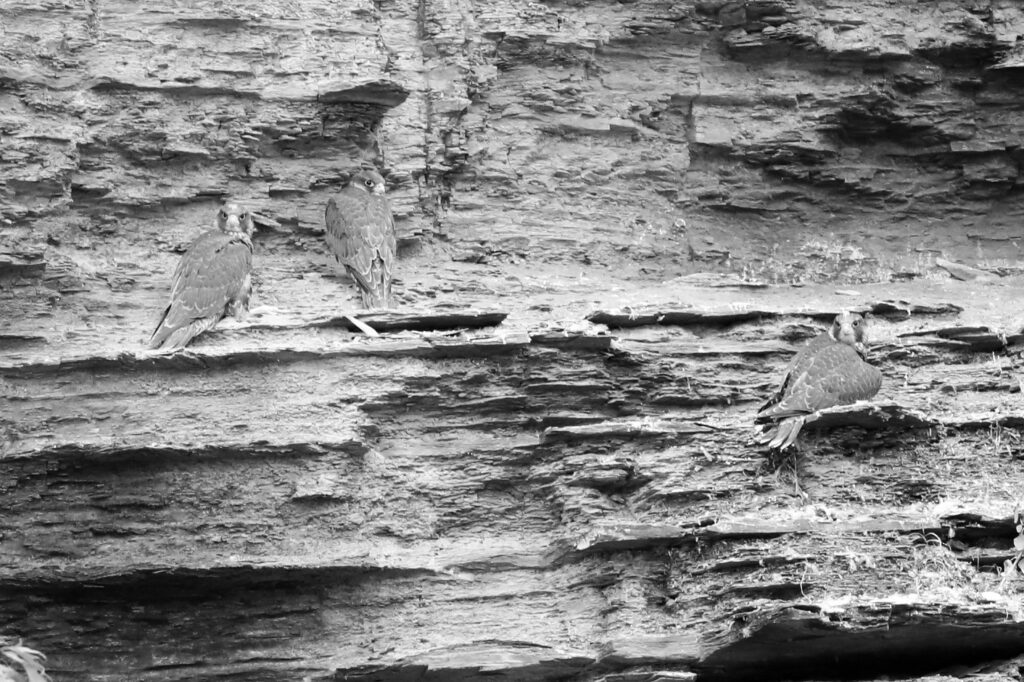
I was recently able to photograph a bird that I’d dreamed of seeing ever since I’d read about them many years ago in a Ranger Rick magazine: the peregrine falcon. I was lucky enough to be able to go on the Teal (the boat of Discover Cayuga Lake), which took us past one of the nests set into the cliffs of the lake.
Peregrine falcons were on the endangered species list (made by the United States Fish and Wildlife Service and the National Oceanographic and Atmospheric Administration) from 1970 to 1999, due to their declining numbers. The main reason for this was the chemical dichlorodiphenyltrichloroethane (DDT), which was used roughly between the 1940s and 1970s as a pesticide. This harmful chemical got into the food chain and harmed so many animals. When the falcons ate their prey (which consists mostly of other birds) that had DDT in their systems, the peregrines got it into their bodies as well, and this caused the shells of the eggs they laid to be extremely thin, which then often broke easily during incubation. Luckily, DDT was banned in 1972, due to the work of scientist Rachel Carson, and since then, these falcons’ populations have dramatically increased.
As soon as we left the dock, we spotted many different bird species. There was a tree full of double-crested cormorants and their nests, mallard duck families, ring-billed gulls, and barn swallows. After we had been sailing for roughly twenty minutes, the boat started to slow—we had reached the peregrines’ area.
One thing that makes peregrine falcons so incredible is their speed and accuracy while hunting. They fly to great heights to search for food, sometimes reaching 3,200 feet! Somehow, with their excellent eyesight, they spot songbirds, rodents, or larger birds like ducks or geese, and begin their dive, or “stoop.” Scientists estimate that their maximum speed is 242 miles per hour, making them the fastest animal on Earth.
The force at which an object or creature accelerates or decelerates is measured in G-forces. We experience one G every day, due to Earth’s gravitational pull; but humans can only experience five Gs before passing out. Peregrine falcons, on the other hand, reach up to twenty-five Gs during their stoops.
When they announced that we were near the peregrines, everyone began looking through their binoculars and cameras to try to find them. I searched the rocky ledge through the lens of my camera, but as these birds camouflage so well with the gray rock, locating them took some time. Finally, we spotted them! I started taking pictures of these beautiful birds, and they didn’t seem to be bothered by the colorful, gigantic, and loud beast floating before them. Then we found one parent, a little farther up the rock, most likely keeping watch for their babies down below. I’d always wished to see peregrine falcons, and here I was, photographing a family of them as they looked straight back at me.
As we turned around and headed back, I stayed with the captain up above and we talked about birds, boats, and captaining. As we talked, I also took pictures of the cormorants, gulls, and other birds that I saw.
Thanks to Rachel Carson and other environmentalists, instead of declining to extinction, the population of these truly incredible birds has risen by several thousand percent in the last fifty years. This has allowed for some of them to make their home here in Ithaca, where we all can experience the thrill of seeing them.