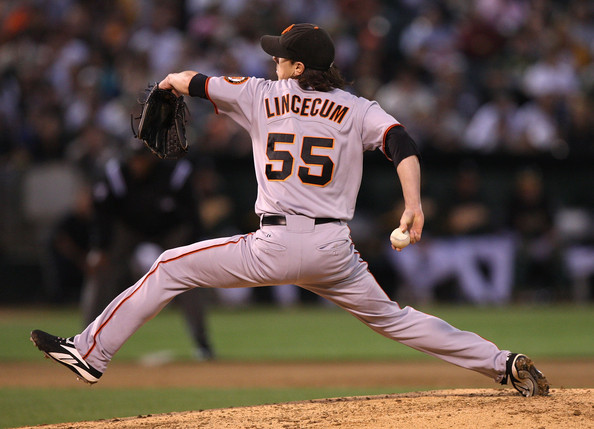
In the early to mid 2000s, pitchers like Tim Lincecum represented something that scouts had never quite seen before. Listed at 5’11” and 170 pounds soaking wet, he generated velocity that had no business coming from a frame that small. Astros’ third baseman Mike Lamb said, “The stuff he was throwing out there tonight was everything he’s hyped up to be. He was ninety seven miles per hour with movement. You just don’t see that every day.” It was so unusual that he was tagged “the Freak”, along with my favorite nickname in all of pro sports, “Big Time Timmy Jim.” He was the polar opposite of the standard fire ballers, such as Randy Johnson, who stood at 6’10” and weighed in at 225 pounds. His motion was no different; it was violent, deceptive, and consisted of a hidden ball, deep coil, explosive release, and whiplike follow through.
Before the 2008 season the Giants’ manager was quoted saying that “there is research that guys who throw 200 innings early in their careers are more susceptible to injuries. We’re aware of that.” Lincecum went on to pitch 227, 225, 217, and 212 innings in the four years that followed. The results were extraordinary: three World Series championships, back-to-back Cy Young Awards, an earned run average in the mid-twos, and a pair of no-hitters. The physical toll was real, though, and the durability that defined his peak eroded quickly. He was an outlier in his era, but he previewed a question that the sport would eventually be forced to answer: how can elite velocity remain reliable?
The answer is rather simple, pitch less. Today, elite speed is no longer reserved for freaks and phenoms. Advancements in mechanics, strength, conditioning, coaching, and nutrition have made it broadly accessible. That normalization of high velocity has come with a significant cost on the human arm. Throwing a baseball at max effort is one of the most violent, unnatural motions in all of professional sports. The harder a pitcher throws, the more stress there is on the shoulder and elbow, and the more time is needed for recovery. When one or two players threw that hard, teams could manage. Now that the entire pitching staff does, it has forced us to rethink how starters are used.
The result is a modern starting pitcher, who looks almost nothing like his predecessor. The concept of a quality start, six innings and three earned runs or fewer, is increasingly becoming a ceiling. Managers often pull starters after five innings, not because they are struggling, but because the analytics say that the lineup is about to see them for a third time.
The numbers tell the story with a blunt clarity. In the 2025 season there were only three pitchers who threw more than two-hundred innings—Logan Webb, Garrett Crochet, and Cristopher Sánchez—a marker that was once considered standard for a front of the rotation starter. That is the fewest ever in a non-shortened season.
Consider what that figure means for Lincecum, who crossed two-hundred innings four consecutive years while posting the best numbers in the National League. On July 13, 2013, he threw a no-hitter against the San Diego Padres, tossing a career-high 148 pitches. In 2026 it no longer reads as an act of utter dominance but of complete recklessness.
The shift towards shorter starts and longer recovery is not without justification. Pitchers injuries, particularly Tommy John surgery, have reached epidemic levels across professional baseball, and organizations have rationally responded by protecting their most valuable arms. In doing so, baseball has lost its dramatic anchor. A figure whose endurance shaped the entire nine inning narrative.