
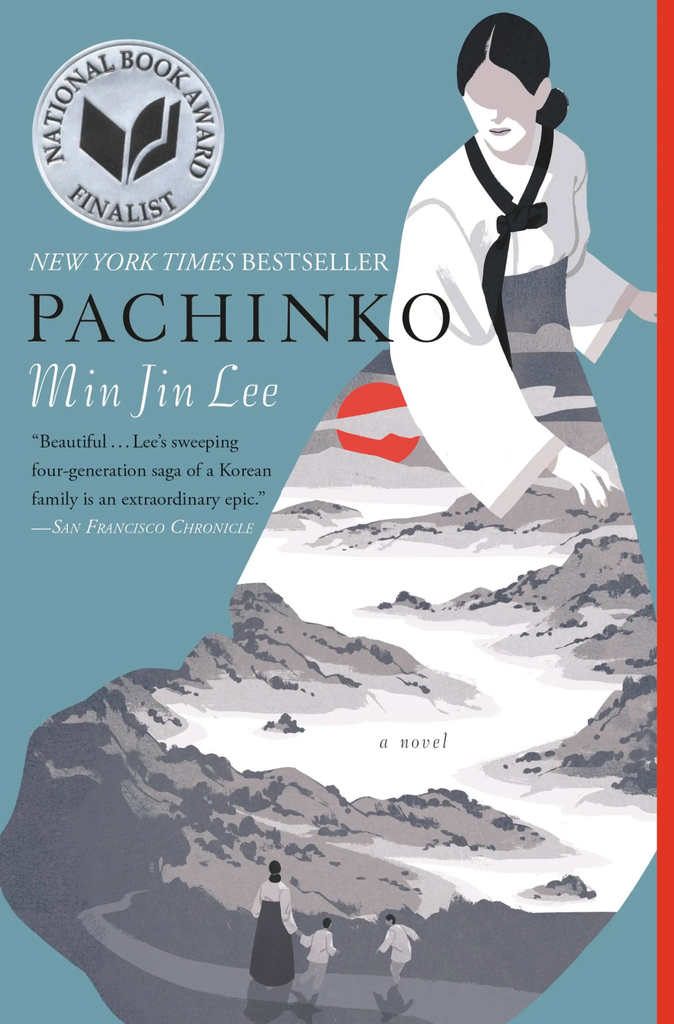
In a sense, Pachinko by Min Jin Lee is a bildungsroman (“formation novel”); a term for a book that charts the course of a character’s life, from beginning to end. Think David Copperfield, or Harry Potter. However, in Pachinko, the main character who flourishes, grows, and changes based on its environment and the people it meets is not a person, like David or Harry. It is a family.
Pachinko begins in Yeongdo, Korea with the marriage of two peasants. After having a child, Sunja, the father dies, leaving the mother and Sunja in charge of their boarding house for fishermen. As Sunja grows up, she develops a friendship with a wealthy man named Koh Hansu who, unbeknownst to her, is a mobster. When he gets her pregnant and refuses to marry, she is forced to marry the kind minister who was living at the boarding house and move with him to Osaka. But her family’s ties to Hansu are not over just yet.
This basic premise seems interesting but not enough to be as highly acclaimed as the novel is. Pachinko’s surprising strength comes from the quiet moments, where people simply live their (sometimes very sad) lives: a wife who learns her husband is a homosexual after seeing him having intercourse in a park, a woman whose children shunned her after learning of her multiple affairs, a young and innocent Korean couple being warned of the troubles that face them in Japan. While some of these characters are only tangentially related to the central Baek family, Lee still takes time to paint a caring and thorough picture of their lives. This is what sets Pachinko apart: unlike other bildungsromane, its focus wanders from the central character. In reality, the main character is not the Baek family; it is the immigrant, the stranger, cast off and discriminated against in a foreign land, who becomes assimilated and finds wealth.
The novel, like any, is not without faults: the prose can be a bit simple for my taste, though that’s just a matter of preference, and while there are large gaps in time in the story, this is just a stylistic choice. A more glaring issue, though, are the plot holes. I won’t spoil the book, but there are strange things happening to the main characters that are not commented on. However, these are minor trifles, and overall, the book is quite enjoyable.
All in all, Pachinko is a great medium-length read, with very strong characters and a good plot. The prose is on the simplistic end, but not at the level of Hemingway, and the book is paced jarringly (chapters can occur years apart), but in an artistic way, creating a snappy and readable story despite the temporal scale on which it occurs. I rate Pachinko 9/10.
Be First to Comment