
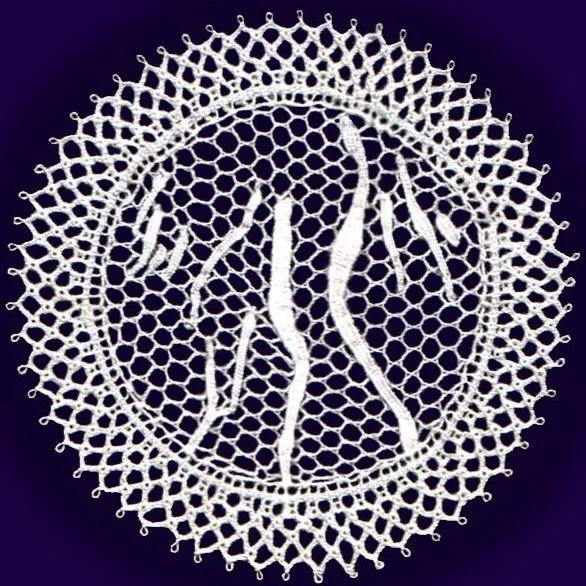
On the 3rd Saturday of each month, a group of lovely people gather in the Lifelong Ithaca center downtown and connect about one thing: lacemaking. The Finger Lakes Lace Guild is a lively group of all ages that work on the traditional art of lace together. Everyone has their own project and has their own style of lacemaking. Some might use bobbins (wooden sticks that hold extra thread and keep everything taught), while others make lace with needles, and others with crochet.
To most, this might sound mundane, but lacemaking is an incredibly complicated craft. As the members of the Lace Guild described it to me, making lace is like weaving with no set direction. For bobbin lace, one piece can use over 120 bobbins (but only four are used at a time) to weave intricate patterns that are held in place by a specialized cushion and pins. In needle lace, artists use delicate thread to create thousands of intricate stitches to form a work of lace. Additionally, crochet lace utilizes a small hook to control where each small loop needs to go.
Lacemaking has been around for centuries. Starting in the early Renaissance, the technique of lace was likely invented by lower class women who were experimenting with their weaving projects. This technique spread throughout Europe as lace became more popular amongwealthy nobles. Since information spread slowly, each region had their own specific styles and secrets creating distinct differences in lace at the time. This made lace very political: people would go undercover to find out the other region’s materials and tricks in order to give themselves a comparative advantage. By the late 1500s, lace was used in the most intricate and elevated wardrobes of the era, almost exclusively being worn by wealthy aristocrats and royalty. As time progressed, lace became more accessible within the middle class and started being open to almost everyone with the development of lacemaking machines.
In our generation, the majority of lace is made with a machine. However, this does not mean we should allow the craft of lacemaking by hand to die. Having people who are interested in lace helps continue the tradition that has been passed down from generation to generation since the 1400s. This incredibly beautiful craft is challenging to master but not impossible. And with an amazing community like the Finger Lakes Lace Guild in our nearby area, I would definitely recommend giving it a try!
Be First to Comment