
Content warning: BoJack Horseman contains depictions of abuse, alcoholism, death, and suicide.
BoJack Horseman is a great work of art. It’s a testament to the form of television, and manages, like all great works, to both use and subvert the expectations of the medium. This is how it cements itself in my hall of fame for television, along with The Good Place and Breaking Bad.
With all works of art, a necessary question to ask when judging it is “why is this work presented in this particular form?” I find this question especially pertinent with television, musical theater, and poetry. All three of these have one trait in common that makes the question important. Namely, there is another art form with very similar qualities, which could easily be substituted in: TV and film, musicals and plays, poetry and prose.
While this article focuses on television, it’s a relevant question to all of those relationships. Why does an artist make a TV show instead of a film? Here’s one possible reason: because TV series can have many seasons, each with ten or more thirty to sixty minute episodes, there is simply a larger timespan to work with. With the extra time, you can develop characters so much more. This is its superpower.
I believe this feature is shared by all of my favorite shows, and justifies their form: they are, at their core, about change. But while The Good Place argues that people can change for the better when given enough time, and Breaking Bad shows how people can be corrupted by power and money very easily, BoJack Horseman manages to show an incredibly balanced portrait of the matter: change is very hard, and many do not try to change, but everyone can do so.
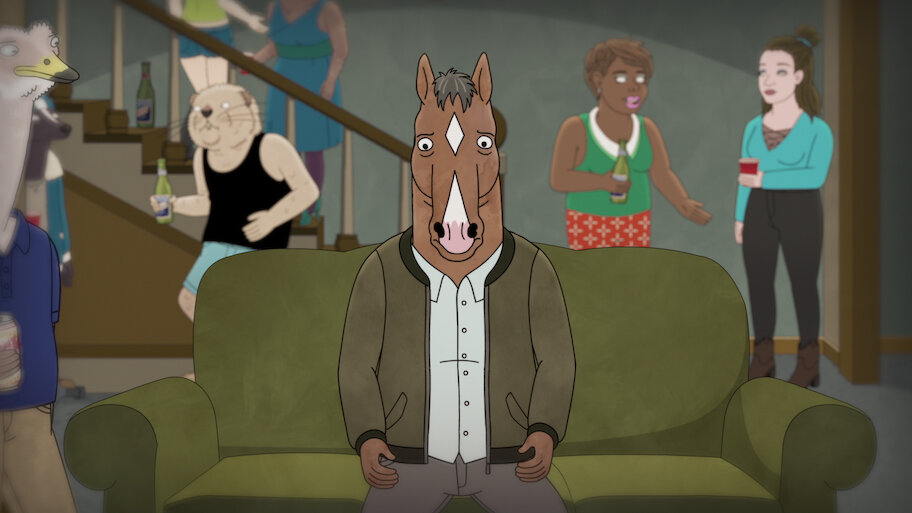
On its surface, BoJack Horseman seems like a strange idea. It’s a cartoon comedy about a depressed alcoholic former Hollywood star (the titular BoJack Horseman), who is a horse. I was, to be honest, a bit put off, but not because of the summary: BoJack starts out awfully. I’m saying this firmly believing it’s a show for the ages, but the first three episodes are quite horrendous. I recommend if you want to watch the show (which you should), just read a synopsis and skip to episode four, which is where it gets good. After that, it just gets better and better. It changes, some may say. And, as with any good show, there are a couple of episodes which have a non-traditional form.
This is another important aspect of a great work of art for me: not only does it use the medium it’s in to convey its themes, but it pushes the boundaries of said medium. “Downer Ending” and “Fish Out of Water” are obvious examples of subverting TV tropes in BoJack, but the best example of pushing the boundaries of the form, and probably the best episode of the show, is Season 5, Episode 6, “Free Churro.” I don’t want to spoil the episode, but the entire thing is one long monologue by the actor Will Arnett (who voices BoJack), and he does a stunning job.
Another notable element of the show, present both in “Free Churro” and the greater show, is its balance of humor and insight. I think that comedies often are better at being reflective and insightful about society because the observations they make can be balanced with humor. If a serious show tried to address the same themes of change and growth, it would come across as more heavy-handed, because it wouldn’t be balanced with humor.
Here’s where I want to get back to the idea of change. Constantly throughout Horseman, BoJack is given the chance to become better. Whether he does is up to him. And unlike Breaking Bad, where the source of the character’s bad actions are his own flaws, BoJack presents his faults as caused in part by his background and life situation.
BoJack realizes the fundamental complexity that The Good Place and Breaking Bad ignore: people are not inherently good or inherently bad. In reality, people are people. This thesis is summed up by his friend Diane when she says “There’s no such thing as ‘bad guys’ or ‘good guys.’ We’re all just…guys, who do good stuff sometimes and bad stuff sometimes. And all we can do is try to do less bad stuff and more good stuff, but you’re never going to be good because you’re not bad.” In other words, while BoJack certainly changes throughout the show, he doesn’t necessarily become a better or worse person. And yet, he definitely changes.
So, how does he change? This changed quality is not easily expressed, but I think the most accurate word for it is maturity. Just as his life choices lead to his bad actions, they are also the source of his change. By becoming more aware of the actions he has done, he becomes more self-conscious about what he will do in the future. So even if his judgment lapses and he behaves badly, he still has the greater insight that he has done wrong. In the words of the seventeenth-century sage Ramak, “Understanding is repentance.” By realizing his faults, even if he sometimes gives in to them, BoJack is a changed person.
In the end, BoJack Horseman is a moral rorschach test. I chose a selection of quotes and themes that supported what I believe to be its central argument, but there are plenty of other scenes that would contradict my statements and support alternative theses. That’s another element of what makes a great work: it is a reflection of the viewer, not of the creator. This is even acknowledged in the show: “Isn’t the point of art less what people put into it and more what people get out of it?,” notes BoJack’s roommate Todd. The only way to see if you agree with my interpretation is to watch the show, which isn’t a bad idea in its own right. If you do so, I firmly believe you’ll be rewarded for your decision. Needless to say, I really enjoyed BoJack Horseman, and give it a 10/10.
Be First to Comment