
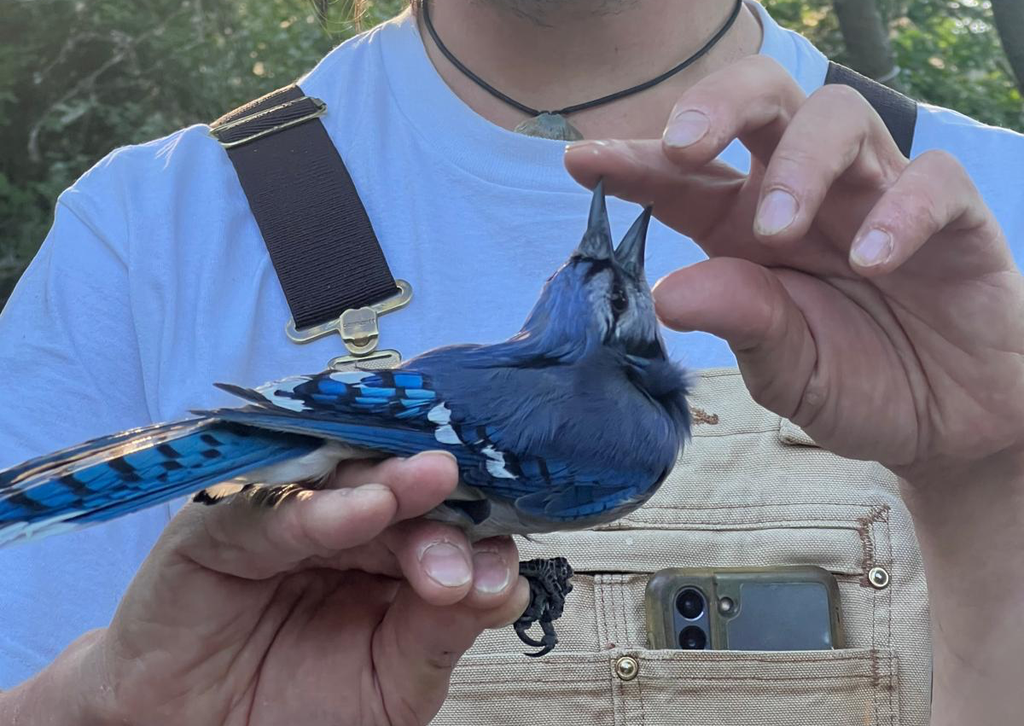
It’s 5:30 AM, and the vast majority of human society is fast asleep, yet beyond walls of concrete and rebar, the world of birds comes alive at dawn. At Lighthouse Point, a slice of land nestled on the southernmost tip of Cayuga Lake, their activity is on stunning display. High above a group of volunteers, ospreys and yellow-warblers shriek their songs to the morning, while a catbird cries its yowling call from a nearby thicket. Each of the gathered people has something in hand: from plastic bags filled with nets they intend to string across common avian highways, to small cloth bags to safely collect the specimens that are caught, and clipboards bursting with columns upon columns of data.
These volunteers are part of the Finger Lakes Bird Observatory and have obtained the necessary training and permits to capture, record, and band local birds as part of the Monitoring Avian Productivity and Survivorship (MAPS) project. Since the late 1980s, MAPS has been led by the Institute for Bird Populations to draw on a collaboration of public and non-governmental forces to document bird populations across the continent.
As the clock hits 6:00 AM, the first group of volunteers heads out to the nets, ten of which are scattered throughout the forest. Thin channels have been cut into the dense walls of privet (an invasive and abundant shrub native to Eurasia), and between them, mist nets are strung. They are an ideal setup to capture birds who are most active in the morning and busy flitting from branch to branch. When a bird is captured, the net-check group, which makes its rounds each half an hour, will carefully remove it from the net, place it in a cloth bag, and return it to a central station. There, it will be weighed; have its wings and tarsus (the equivalent of the bird’s ankle) measured; its sex, age and a multitude of information about its condition recorded; and finally banded. The bands are small metal rings, specially sized for each bird and registered in numerical order. They have little to no effect on the birds and after they are applied a bird can be released. The system moves quickly and efficiently, even as more and more birds are caught as their activity peaks around three hours after sunrise.
This work is critical as industrialization, agriculture, and diseases such as West Nile virus and the avian influenza continue to have detrimental effects on the well being of bird populations, effects that must be studied and acted upon before it is too late, and we lose these wonders of nature for good.
Be First to Comment