
Did you know that The Tattler is one of the oldest school newspapers in the country? With prints dating as early as 1892, you can find almost anything you could wish for. Our humble publication has produced over a thousand issues in its history. Without further ado, here are just a couple highlights from throughout the years. I hope you have as much fun reading my selections for this month as I had picking them out!
June 2017
Country Music Ain’t So Bad
By CHLOE WRAY
Prior to 2011, my association with country music consisted primarily of scoffing when the school bus driver blasted QCountry, and equating the twangs of the genre to Republican hunters and farmers. My perspective began to shift and my tastes began to widen after my mom began dating a country music-loving, golf-playing Republican from Texas. The guy turned out to be a jerk, worthy of a Carrie Underwood-esque revenge song, but what I saw then as a blip in my mother’s life sparked a trend towards my ever-broadening appreciation for
country music.
Country music has its origins in the 1920s, stemming from the songs of Old England that were carried over in the 1700s and the blues influences of the Deep Southern African Americans, evolving eventually into the folk ballads of Appalachia. The homegrown strummings of the working class that proclaimed their trials and triumphs have remained a constant characteristic of Americana since its conception. The acoustics of classic country embody backroads and simpler times.
Mainstream culture has played its part in shaping current country artists and the genre itself as it shifts into an increasingly pop-y form, but the motifs of tractors, women, and beer remain staples. What draws me to country music, besides the easy listening (once you get over the initial grating factor of the singers drawls), is the lyrical genius of the songs. Being mainly acoustic, country music owes much of its appeal to the value of a story. The genre has a tendency to be discredited by some due to its perceived fan base, thought of as uneducated or redneck, and that songs of driving on a dirt road with a girl are just as simple as their audience. But paying closer attention to the lyrics reveals that the sagas that play out are chock full of clever lines and heartfelt sentiment.
The following playlist is comprised of some of my favorite songs that encompass the far-reaches of a genre that spans the entire country.
“Goodbye Earl”: The Dixie Chicks
An oxymoron to most country stereotypes, the Dixie Chicks are known for their opposition to George Bush and the war in Iraq and were heavily criticized by the country music industry.
This song involves women’s empowerment from cheating husbands and arsenic in black-eyed peas. Also check out “Travelin’ Soldier,” a tear jerker of a story and one of my all-time favorite songs since age six.
“One Piece at a Time”: Johnny Cash
A song about a mismatched, hodge-podge, janky car and lowkey criminal activity. What’s better than that? The best of country, Johnny, that’s what.
“Colder Weather” and “Sweet An-nie”: Zac Brown Band
Best enjoyed sequentially, these two songs are beautiful. I recommend driving at night when you’re kinda sad and singing or crying along to these ballads.
“You Never Even Called Me By My Name”: David Allan Coe
Fitting as an introduction to country music because about two-thirds of the way through the song, it explicitly lists all the necessities of a country music song.
“Wheels”: Flying Burrito Brothers
If the band’s name alone doesn’t win you over, give it a listen.
“People Are Crazy”: Billy Currington
I told Rafael Enciso-Oddy ’17 that I was writing this article and he dared me to convince him that country was not awful. I brought up this song as an example of the genre’s laughability. After I read the lyrics aloud to him, we both agreed that “God is great, beer is good, and people are crazy,” but also that there is lyrical prowess in the country music genre.
“Cornbread and Butterbeans”: Carolina Chocolate Drops
Not necessarily considered country—more folksy, perhaps, but worth the genre bending to fit it onto this playlist. Try not to dance, and just try to get it out of your head.
June 2002
Virtues and Vices
Compiled by DAVID DURRETT
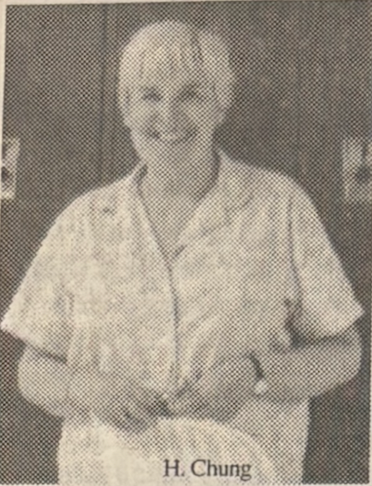
Ms. Spanswick was inspired to teach English because of enthusiasm with communication towards all people and a lack of interest towards math. A teacher called Ian Smail also influenced her. She has been teaching since 1964, in every grade level except 11. Of all the books she has taught, her favorite is Winnie the Pooh. She feels that film adaptations of books are generally varied in faithfulness, but likes Coppola’s works Hearts of Darkness and Apocalypse Now. Upon reincarnation, she would like to be the kind of thistle that defeated the English army in Scotland.
Vices
Gluttony: I got fat on chocolate-covered peanuts.
Sloth: Only in the early morning.
Wrath: My hair stands on end and my eyes shoot fire. It’s a scary sight.
Envy: I envy all those who can eat anything they want to without gaining weight.
Avarice: I am jealous of people whose grandchildren live nearby.
Lust: Sean Connery and Ewan McGregor.
Virtues
Hope: I have hoped and still hope that all my students will have happy, fulfilled lives.
Charity: Giving students yet another chance.
Justice: Do your work, try hard, get a good grade.
Faith: That all my students will learn something.
Fortitude: I am still teaching.
Prudence: Be prepared.
September 1992
Is Drivers’ Education a Privilege or a Right?
By TSITSI MCPHERSON
“Drivers’ Education is not mandated by New York State,” says Constance Paterson, head of the Board of Education. In order to lower the district’s budget, “Cancelled” was heard in response to drivers’ education. One of the most productive, effective, and important programs of the Ithaca High curriculum was on the cutting board again. The students were up in arms, feeling they had been cheated. A petition was started, with full support of the parents, allowing a majority of the student body to voice their view.
But did the petition have any bearing on the reinstatement of Drivers’ Ed.? “No,” says Paterson, “not in my opinion.”
Mr. Bouton who has taught drivers’ ed. for 30 years at IHS, says “Drivers’ Ed. has been on district’s cutting board four or five times.”
If Drivers’ Education has always been reinstated, why then does the school board consider
cutting the program? Drivers’ Ed. is not mandated by the state and “Studies have shown that students taking drivers’ education in school does not ensure safer drivers,” says Paterson.
While the students and the parents find the program financially helpful, most schools, such as those in Trumansburg, have classes that have to be paid for over the summer.
We, the student body, should be thankful that the majority of the school board chose to reinstate Drivers’ Education. But the school board should remember that Drivers’ Education cannot be cancelled at any time, because some students cannot afford lessons, and most importantly because the jobs of those who teach drivers’ education will be on the line.
June 2017
ICSD Creates a Mobile App
By ZACHARY FOLEY
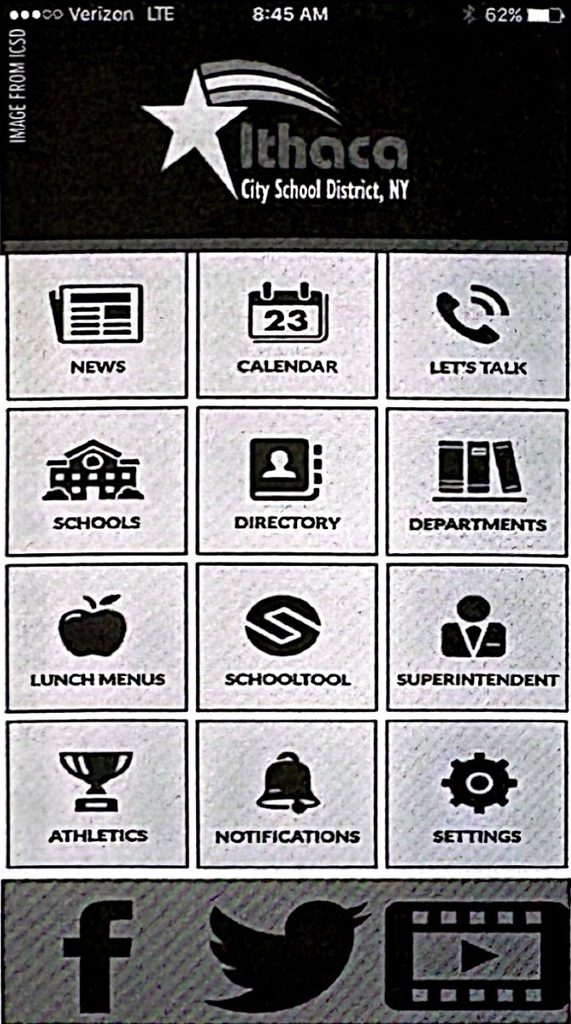
When ICSD launched its new mobile app, I decided to download this recent effort by ICSD to explore a new medium to interact with the community. ICSD Superintendent Luvelle Brown described the app as “an example of our commitment to two-way communication.” Overall, after exploring the app and its many functions, the new app is mainly geared toward providing the user with general information about the district while providing a few new options unavailable through the website.
The app first allows you to choose a school.
Then, the user is greeted with the home screen of the app, which features twelve buttons under the ICSD logo. Some direct you to the corresponding parts of the district website while others go to pages with information, such as contacts at the school and district news. The app itself is currently limited to the same functions as the ICSD website but reformatted.
Under the Departments tab, the user can choose to expand information about a specific ICSD department, which in turn redirects you to their individual page or directory. This part of the app provides phone numbers and emails that you can conveniently click on to contact school officials. The news section provides another useful feature. ICSD chooses to publish most current school news on their Twitter feed, which is often blocked on school WiFi, so students and staff will benefit from having access to district news on their cellular devices.
The most innovative aspect of the app is the district’s new “Let’s Talk” function, which allows users, parents, and all community members to comment on schoolwide issues including academics, the specifics of the current and planned school budget, and specific student concerns. Overall, while the user interface of the app is simple and at times squeezed, the organization of the app is convenient and far easier to navigate than the ICSD website.
Many IHS students voiced their opinions regarding the app. “The mobile app is just a mobile interface of the online website,” said Jefferson Sheng ’20. Alex Whitehead ’20 added that
“Although currently the number of uses of the app may be small, it has potential to benefit the ICSD staff and students.” The release of a mobile app seems to be a step in the right direction for ICSD as it moves toward finding new mediums to connect and communicate with the community.
September 1992
Graphic
Be First to Comment