
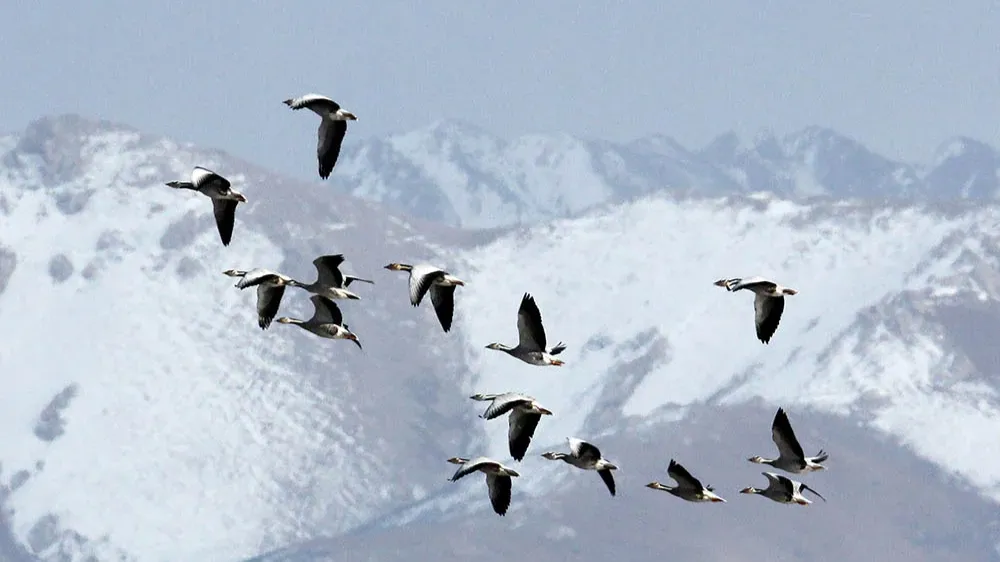
Arrows in the sky pointing due south, filling the air with their cacophonous cries, the Canada geese, are commonplace in Ithaca’s fall. Equally common, though less obvious, are the twilight flights of warblers and sparrows in the hours after sundown. These mass movements of birds are hallmarks of the impending chill of winter and eventually, upon their return, the flower buds of spring. Yet, most people take them for granted without considering the evolutionary wonder behind the twenty thousand foot altitude migration of the bar-headed goose, nor the nearly sixty thousand mile flight of the arctic tern.
The question of why birds began migrating has stumped ornithologists for generations. In the modern day, we have made substantial strides in identifying the most likely explanation, though evolutionary processes that occurred over millions of years are difficult to capture with short-term data.
The currently accepted hypothesis is that the ancestors of migratory birds began as non-migratory but would make small movements away from their breeding ranges as seasons changed in order to have better opportunities for foraging. Those that moved further South tended to have access to more food and were therefore more likely to survive the winter. Birds with a stronger tendency to travel ended up with more offspring come spring. Over time, birds would begin to move further and further Southward, because the risks of long travel were outweighed by more abundant food sources.
Research has corroborated this idea by documenting that—within the Northern Hemisphere —birds migration paths lead almost exclusively from north to south, implying that their movements are in the interest of fairer climate and plentiful food.
Yet, even with the promise of food, it is difficult to understand how, year after year, birds are able to follow the nearly identical and sometimes apparently nonsensical paths across continents and oceans to reach the same location.
The answer lies in the magnetic fields of the Earth, the same ones that make compasses point north, allowing birds to fly towards their destination. Since, migration paths are north to south the strength of magnetic fields will change depending on the bird’s latitude. Through a process called the radical pair mechanism, which uses photochemical processes sensitive to magnetic fields, birds are able to react to changes in these magnetic fields in order to fly in the same direction to the same location year after year. This incredible outcome of evolution seems to be attributed to a single protein, cryptochrome 4, which has been linked to the increased sensitivity of migratory birds to magnetic fields.
Migratory birds, with their ability to not only travel distances that seem far beyond their physical capacity but also navigate without the help of technology, are a seasonal reminder of the incredible leverage of evolutionary forces.
Be First to Comment