
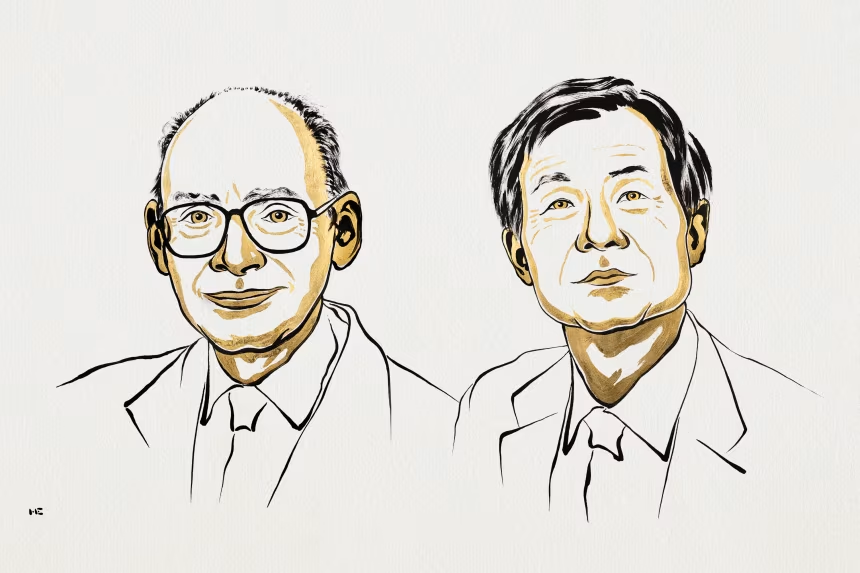
The Nobel Prizes are a set of six international awards to honor people who have made the greatest contribution to humanity in their respective fields. This year, Henri Kagan and Kenso Soai received the Nobel Prize in Chemistry for their groundbreaking work that helps us understand and control the creation of specific molecules used primarily in medicines and adds to our understanding of the formation of the world.
Kagan and Soai’s work focuses on a specific structural property of molecules, called chirality. It can be easily thought of with the hands as a model. Molecules are said to be “right-handed” because they can have an opposite “left-handed” version of themselves called enantiomers. These molecules cannot be rotated or arranged in a way that makes the molecules completely the same image of each other, rather they will always be mirror images.
You can try this yourself! Imagine your hands are enantiomers of each other. Orient your hands together over each other so that every detail is the same. Eventually, you’ll find out that it is impossible to do this while keeping the backs of the hands over each other and having the fingers overlap. Because of this, enantiomers are shaped differently and behave differently as well.
This property is what defines us. Amino acids used in proteins are “left-handed,” while sugars, like deoxyribose and ribose (in DNA and RNA, respectively) are “right-handed.” Many medicines exhibit chirality and only one type can produce desired effects. The other’s effects could be detrimental. A classic example is Thalidomide, a “miracle” drug that was able to help women with anxiety, insomnia, and morning sickness during pregnancy. While the right enantiomer accomplished this effect, the left enantiomer caused babies to have severe limb malformations. Because of the inability to successfully control the ratios of which enantiomers were present in the drug, many women believed that the drug worked, until their babies came out with birth defects.
The work that led to the awarding of the Nobel Prize focused on the controlling of the creation of either right or left handed molecules. Initially, the creation of drugs in a lab setting had one to one yields of right and left handed molecules. These two set out to try and create a much more pure product.
Kagan’s experiment used chiral catalysts, which are molecules that speed up a reaction and also exhibit chirality. The key point is that a small change yielded a large difference in the later reaction, creating a nonlinear behavior in chirality reactions. He noticed that a tiny imbalance, such as fifty-one percent right and forty-nine percent left catalyst, can snowball into a much bigger reaction that yields a much higher concentration of the right catalyst.
Inspired by Kagan’s idea, Kenso Soai set out to create a similar reaction but make it go on without the intentional imbalance between the right and left catalysts, as well as find a catalyst that can autocatalyze, or perform the reaction onto itself. Through his experiments, Soai discovered a reaction between nonchiral molecules that produced a chiral catalyst. This new catalyst also had the ability to autocatalyze and amplify itself. With this, Soai found a reaction where chirality emerges spontaneously from the reaction. Essentially, the creation of the chiral catalyst that is able to autocatalyze has a random handedness. This catalyst then goes on to amplify itself, creating even more copies of itself in the mix, which repeat the process. At its best, the solution is 99.99 percent either left handed or right handed.
The results of Kagan and Soai’s experiments are more important than just chemistry concepts. By making a better yield in chiral reactions, the creation of medicines of a specific handedness will become much cheaper and more efficient, leading to better access to medications for all. Additionally, Kagan and Soai’s work gives chemistry a realistic mechanism of explaining the origin of life and the chirality of amino acids and genetic sugars. Although we do not fully know the true reason for this, and their work has yet to be fully replicated or utilized, the work of Kagan and Soai give us a clearer pathway to understanding life as well as improving it through chemistry.
Be First to Comment